The Best Waterfalls in the Philippines: 14 Worth the Trek
The best waterfalls in the Philippines are Kawasan and Tumalog in Cebu, Cambugahay on Siquijor, Tinago near Iligan, the Niagara-wide Tinuy-an in Surigao del Sur, Aliwagwag and Asik-Asik in Mindanao, and the canoe-run Pagsanjan in Luzon — turquoise pools and curtain drops, most reachable in a half day with a small fee and a guide.
That is the short version. The long version is this guide, because I have spent the better part of three trips driving south Cebu’s coast road, descending step counts that lie to you, and arguing with habal-habal drivers over the going rate to a trailhead. The country has hundreds of cascades — Cebu island alone claims over a hundred — and the truth is that some are genuinely worth crossing the archipelago for and some are a muddy thirty-minute walk to a trickle. This list sorts them out: fourteen falls ranked by region, with what makes each one special, exactly how to get there, the current entrance and guide fees in pesos and dollars, the season to aim for, and an honest call on whether it earns the detour.
If you are still building the wider trip, start with our guide to the best things to do in the Philippines and slot the waterfalls in around the island hopping and the reefs. Chasing falls pairs naturally with a south Cebu base, a Siquijor detour, or a Mindanao road trip, and almost none of them needs more than a morning.
A note on money and timing before we start. Peso figures convert at roughly PHP 58 = USD 1, and I have rounded the dollars; treat both as 2026 ballparks and confirm at the gate, because barangay councils adjust fees and add life-vest charges without warning. On season: nearly every waterfall here runs fuller and louder in and just after the rains (roughly June to November), while the dry months (December to May) give you easier roads, clearer pools and safer rock. When the two pull in different directions, I say so in the entry.
The Best Waterfalls in the Philippines, Region by Region
Here is the whole list at a glance before we go deep. Fees are per person unless noted, and “how to reach” assumes you are starting from the nearest sensible hub.
| Waterfall | Region | How to reach | Fee (approx.) | Best for |
|---|---|---|---|---|
| Kawasan Falls | Badian, Cebu (Visayas) | Bus Cebu City–Badian ~4 hrs; or base in Moalboal | PHP 200 ($3.50) entry; canyoneering PHP 1,500 ($26) | Turquoise pools + canyoneering finale |
| Tumalog Falls | Oslob, Cebu (Visayas) | Habal-habal from Tan-awan, Oslob (PHP 50–100) | Free–PHP 50 ($0–0.90) | Misty curtain, easy add-on to Oslob |
| Cambugahay Falls | Lazi, Siquijor (Visayas) | Scooter or tricycle from Siquijor town | ~PHP 50 ($0.90); rope swing PHP 50 | Rope swings into turquoise tiers |
| Lugnason Falls | San Juan, Siquijor (Visayas) | Short walk off the San Juan ring road | Token donation (~PHP 20) | A quieter Siquijor swim |
| Casaroro Falls | Valencia, Negros Oriental (Visayas) | Jeepney from Dumaguete + habal-habal; ~335 steps down | PHP 30 ($0.50) | A dramatic single plunge for hikers |
| Aguinid Falls | Samboan, Cebu (Visayas) | Bus to Samboan, south Cebu | PHP 300 ($5) incl. guide & gear | Climbing a multi-tier limestone staircase |
| Inambakan Falls | Ginatilan, Cebu (Visayas) | Bus to Ginatilan, south Cebu | PHP 50 ($0.90) | A tall plunge into a wide blue pool |
| Tinago Falls | Iligan / Lanao del Norte (Mindanao) | Jeepney to Buru-un + habal-habal; 300–500 steps down | PHP 60–65 ($1) | A “hidden,” deep-gorge swim |
| Tinuy-an Falls | Bislig, Surigao del Sur (Mindanao) | Fly to Davao/Butuan, van to Bislig, habal-habal | PHP 50 ($0.90) + PHP 30 vest | The widest curtain in the country |
| Aliwagwag Falls | Cateel, Davao Oriental (Mindanao) | Bus/van to Cateel + tricycle 13 km | PHP 100 ($1.70) | A 130-tier “stairway” cascade |
| Asik-Asik Falls | Alamada, North Cotabato (Mindanao) | Long drive from Davao/Cotabato + habal-habal | PHP 40–70 ($0.70–1.20) | Water pouring from a wall of ferns |
| Pagsanjan Falls | Cavinti, Laguna (Luzon) | Bus from Manila to Pagsanjan/Cavinti (~2.5 hrs) | Boat run ~PHP 1,350 ($23) + entry | Shooting the rapids by dugout canoe |
| Kabigan Falls | Pagudpud, Ilocos Norte (Luzon) | Bus to Pagudpud + tricycle; 20–30 min flat walk | PHP 20 ($0.35) + guide PHP 100 | An easy family-friendly trek up north |
Now the detail, region by region, starting where most travelers do.
Cebu and the Visayas: Turquoise Pools and Rope Swings
The Visayas is the spiritual home of the Philippine waterfall. The limestone here filters the water into that improbable Gatorade-blue, the islands are small enough to chain three falls into one day, and the south Cebu coast road strings the best of them together like beads. If you only have time for one waterfall region, make it this one. Our full Cebu travel guide covers where to base yourself; for the falls themselves, here are the ones I send people to.
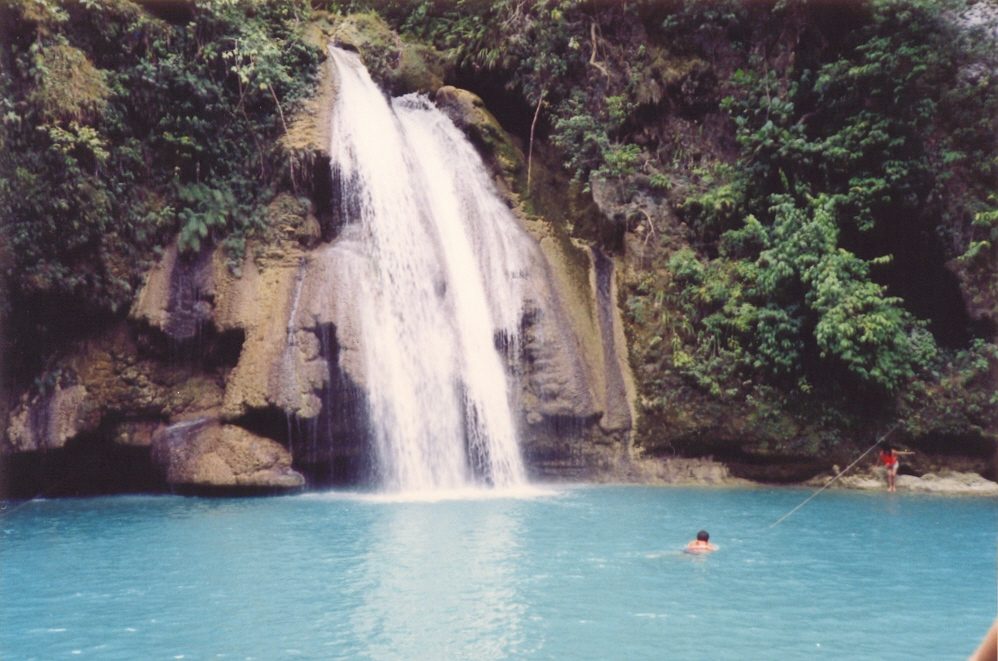
Kawasan Falls, Badian — the famous one, and the canyoneering finale
Kawasan is the waterfall that launched a thousand Instagram posts, and for once the hype is mostly earned. A three-tier cascade pours off the Matutinao River into pools so vividly turquoise they look color-graded. You can simply walk in: from the highway in Badian it is a flat, shaded fifteen-minute riverside stroll to the first pool, where bamboo rafts ferry visitors under the falling water for a few hundred pesos. Plain entry runs about PHP 200 ($3.50).
But the reason Kawasan is on every Cebu itinerary is the canyoneering. You start upstream near Alegria and spend three to four hours working down the gorge — swimming through slot canyons, sliding natural rock chutes, and leaping from ledges that begin at a polite three meters and escalate to a genuinely frightening ten to twelve (every jump is optional; there is no shame in the walk-around). Kawasan itself is the triumphant final drop. The price is now regulated by the local government at roughly PHP 1,500 ($26) per person, which includes an accredited guide, helmet, life vest, the habal-habal to the jump-off, and lunch. Booked from Moalboal it runs PHP 1,500–1,800; with transport from Cebu City or Mactan, PHP 2,000–2,500.
How to get there: from Cebu City’s South Bus Terminal, take a Ceres bus toward Bato via Barili and ask to be dropped at Kawasan/Matutinao — about four hours. Most people instead base in Moalboal, fifteen kilometers north, and ride down in the morning.
Best season: the canyoneering only runs when water levels are safe, so operators close it after heavy rain. December to May is the reliable window, and the pools are at their bluest in the dry season anyway.
Worth it / skip if: worth it — the canyoneering is one of the best half-days in the country. Skip the walk-in-only visit at midday in high season, when the first pool fills with rafts and selfie sticks; go at opening (8am) or do the canyoneering route, which leaves the crowds behind.
Tumalog Falls, Oslob — a curtain of mist for almost nothing
If you have come to Oslob — and many people do, for the controversial whale-shark feeding I would steer you away from — Tumalog is the redemption stop ten minutes up the hill. It is not a thundering plunge but a wide, soft veil of water falling through hanging vines and tree roots into a shallow, milky-blue pool. Late morning, when sunlight angles through the spray, it turns the whole grotto into something close to a cathedral. Entry is free to about PHP 50 ($0.90).
How to get there: the access road is steep enough that habal-habal drivers wait at the Tan-awan junction in Oslob and run you up for PHP 50–100 each way. Walking down is fine; walking up in the heat is a penance.
Best season: any time, though after rain the curtain widens into something properly dramatic. In the driest weeks it can thin to a trickle.
Worth it / skip if: worth it as an easy, cheap add-on if you are already in Oslob. I would not drive three hours from Cebu City for Tumalog alone — pair it with the Sumilon sandbar or a south Cebu loop.
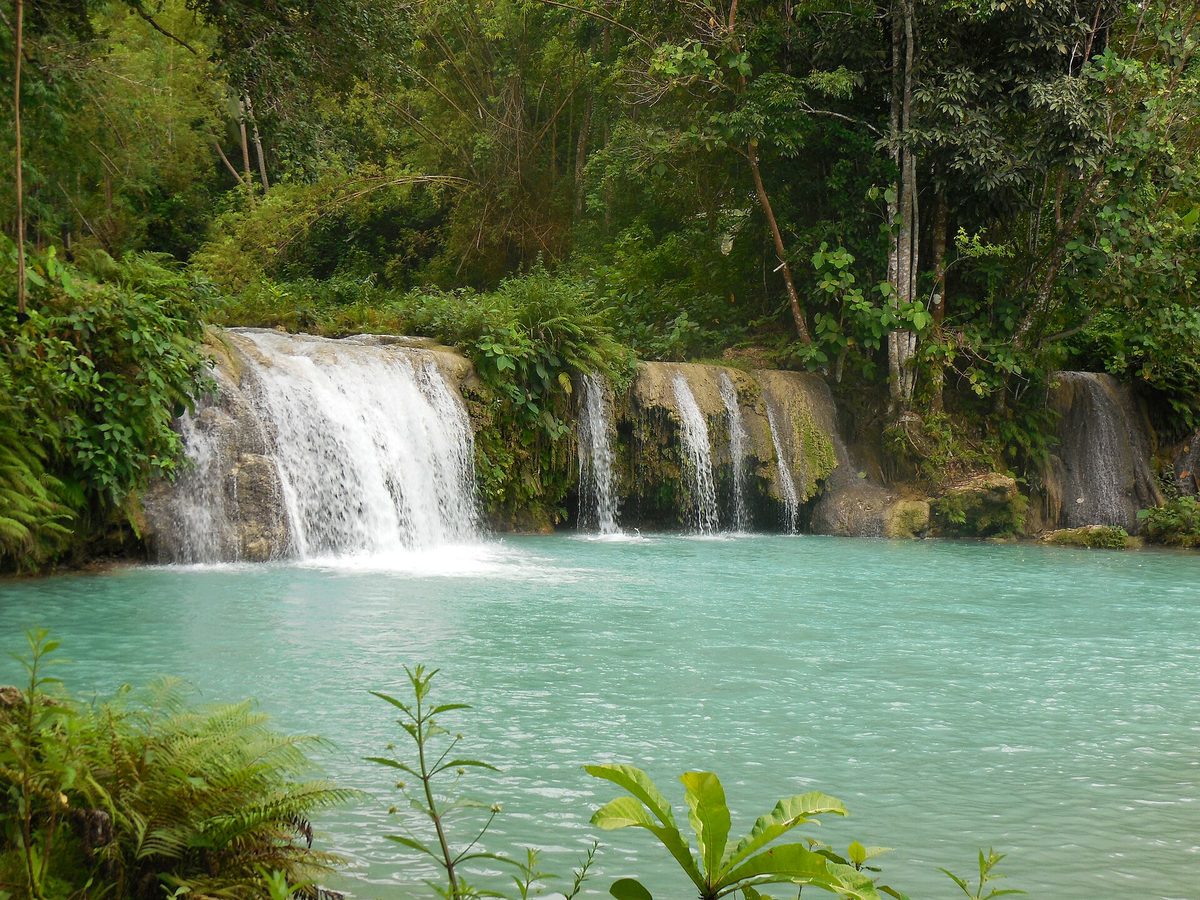
Cambugahay Falls, Siquijor — the rope-swing classic
Siquijor trades on its folk-magic reputation, but its real spell is Cambugahay: three stacked tiers of turquoise water near Lazi, cool and deep enough to swim, with the now-iconic rope swings and bamboo Tarzan platforms launching you off the side into the pool. It is unapologetically fun, the kind of place where you mean to stay an hour and lose three. Entry is around PHP 50 ($0.90); the rope swing and raft are about PHP 50 more for unlimited turns.
How to get there: Siquijor is a small island and a rented scooter is the way to do it — Cambugahay is a 20-minute ride from the port at Siquijor town, then a flight of concrete steps down to the water. Tricycles will also take you for a negotiated fare.
Best season: the turquoise is most vivid in the dry season (December–May). Heavy rain can cloud the water brown and make the steps slick.
Worth it / skip if: worth it — it is the best swim-and-play waterfall in the Visayas. Skip the midday tour-bus window if you want the pools to yourself; arrive before 9am or after 3pm.
Lugnason Falls, Siquijor — the quieter alternative
If Cambugahay is crowded, or you simply want a calmer dip, Lugnason near San Juan is the locals’ pick: a single clean drop into an emerald basin, a short walk off the ring road, often with a resident who has strung up his own rope swing and asks only a small donation (around PHP 20). It rewards the few who bother.
Worth it / skip if: worth it as a peaceful counterpoint on a Siquijor scooter day. Skip it if your time is tight and you have already done Cambugahay — they scratch the same itch.
Casaroro Falls, Negros Oriental — a plunge that makes you earn it
Across the strait from Siquijor, near Dumaguete, Casaroro is the Visayas’ most photogenic single plunge: a narrow 30-meter ribbon firing into a boulder-strewn pool inside a mossy ravine. Getting down means a steep staircase of roughly 335 steps (the number varies by who is counting), then some boulder-hopping, and of course climbing all of it back out. Entry is just PHP 30 ($0.50).
How to get there: from Dumaguete, take a jeepney to Valencia, then a habal-habal to the trailhead (around PHP 200–300 round trip, with the driver waiting). A guide is sometimes required and worth it after rain.
Best season: dry season for safe footing on the steps and boulders. The falls run hardest just after rain, but that is also when the descent is most dangerous — do not push it.
Worth it / skip if: worth it for anyone who likes a bit of effort with their reward. Skip it if knees or heat are a problem, or if water levels are high and the lower boulders are submerged.
Waterfalls Near Cebu: The Whole South-Coast Cluster
Kawasan gets the headlines, but the smartest thing about chasing waterfalls near Cebu is that you do not have to choose. The southern stretch of the island — roughly Badian down through Alegria, Ginatilan, and Samboan to the Negros ferry at Liloan — is studded with falls within a few kilometers of the coast road, and a rented motorbike or a hired driver can link four or five in a single day. Cebu island claims well over a hundred named cascades; here are the ones near the south coast that justify a stop.
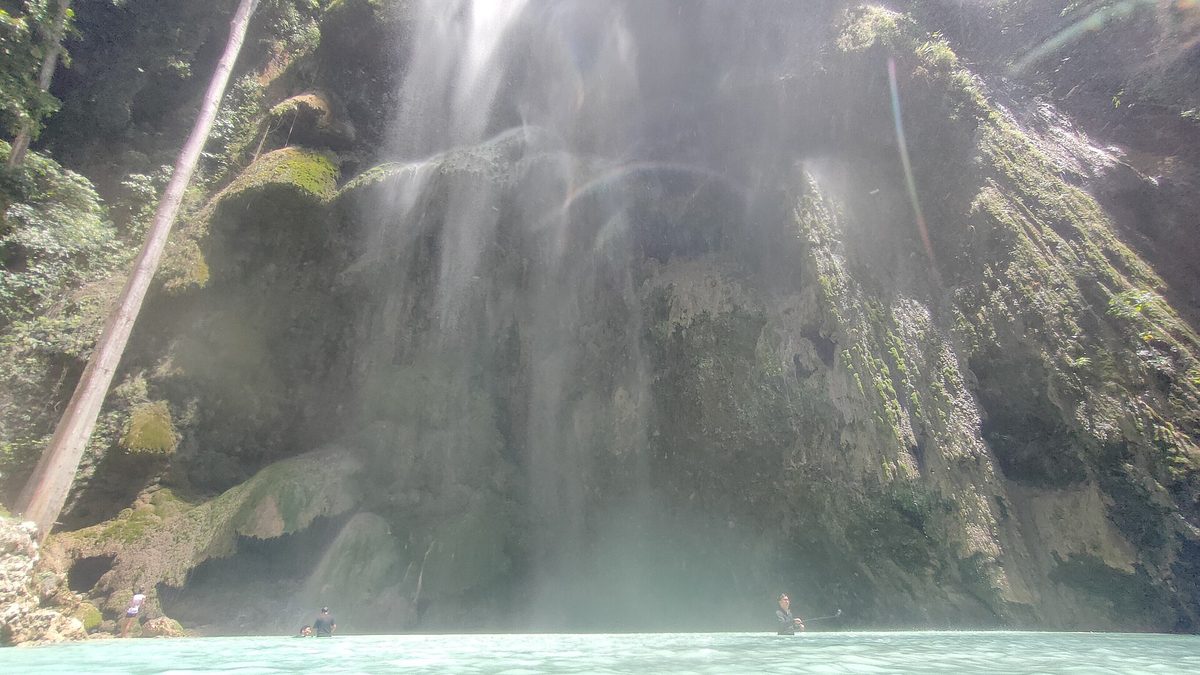
- Aguinid Falls (Samboan) — not so much a waterfall as a climbable limestone staircase: five-plus tiers of travertine you scramble up with a guide, gripping the rock as the water sheets past. The PHP 300 ($5) fee includes the compulsory guide and safety gear, and the guides earn it. Genuinely the most hands-on falls in south Cebu.
- Inambakan Falls (Ginatilan) — a tall, forceful plunge into a broad blue pool ringed by jungle, with smaller tiers above. Entry is about PHP 50 ($0.90) plus a few pesos for parking. Less developed than Kawasan and all the better for it.
- Binalayan Hidden Falls (Samboan) — a deep blue pool with a cave behind the curtain and cliff-jumping ledges on the side. Entry around PHP 100 ($1.70). The pool is shallower than it looks, so let the guide show you the safe jump spots before you launch.
- Dao Falls (Samboan) — a quieter twenty-to-thirty-minute jungle walk to a pretty multi-strand fall; entry around PHP 200 ($3.50). The trail is clear enough that the mandatory guide is more good company than necessity.
- Mantayupan Falls (Barili) — the tallest in Cebu at around 98 meters, set in a natural amphitheater of trees an hour or so south of the city; a low-effort stop if you are driving down rather than basing in Moalboal.
My honest take on the cluster: do not try to do all of them. Three falls in a day is a good time; five is a wet, rushed checklist. I would pair Kawasan canyoneering on day one with Moalboal’s sardine run, then spend a relaxed second day looping Aguinid, Inambakan, and Tumalog by motorbike. The south coast also happens to be where Cebu’s best swimming and snorkeling live, so build in beach time. For the bigger picture on getting around the island, the Cebu travel guide has the bus and ferry logistics.
Mindanao: The Country’s Biggest, Widest and Strangest Falls
Mindanao is where the waterfalls go large. Fewer tourists make it down here, the falls are bigger and wilder, and a couple of them are genuinely unlike anything in the rest of the country. Travel takes more planning — you are flying into regional airports and stitching together vans and habal-habal — but the payoff is scale and solitude.
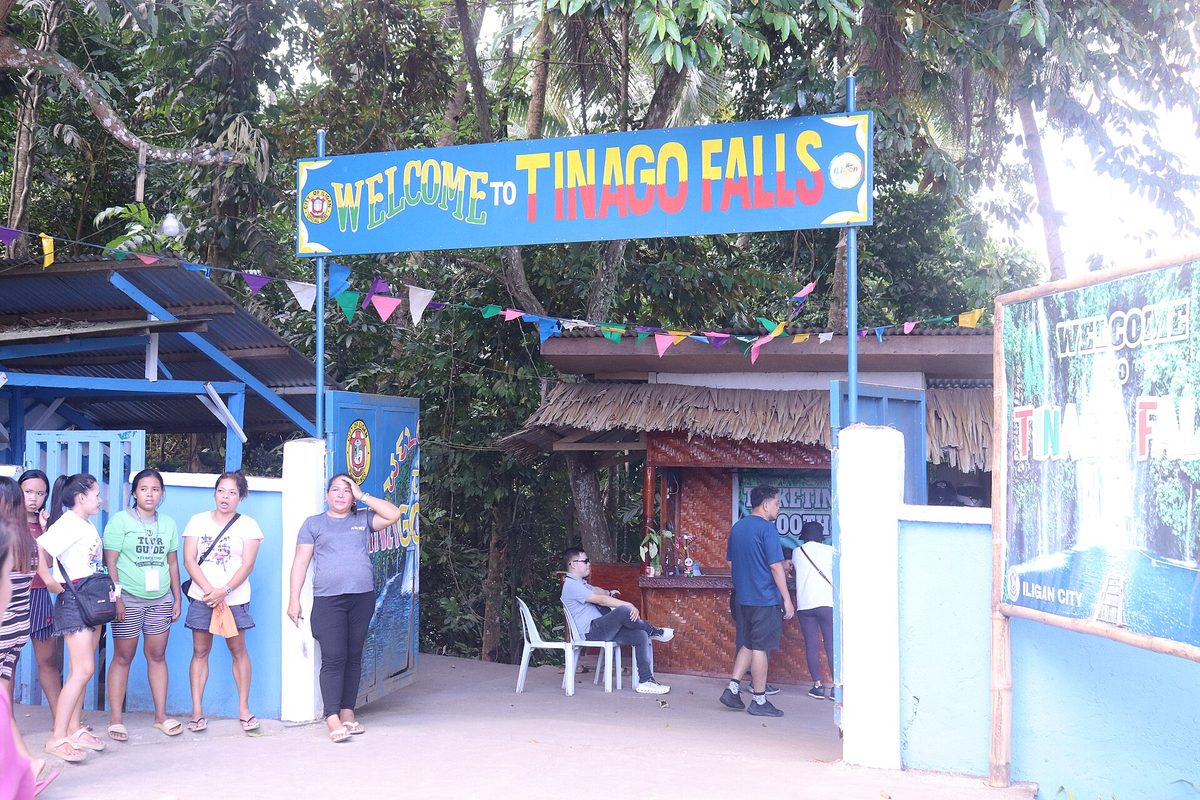
Tinago Falls, Iligan — the “hidden” one at the bottom of the stairs
Tinago means “hidden” in the local language, and it earns the name: the falls sit at the bottom of a deep gorge near Iligan, invisible until you have descended the long concrete staircase to reach them. Count on 300 to 500 steps depending on which trail you take — the older Buru-un route on the Iligan side is the longer one, around 500 steps; the newer Linamon route is roughly 360. At the bottom, a powerful 70-meter curtain pours into a deep blue basin you can swim across to a little bamboo raft. The climb back up is the price of admission, and it is steep. Entry is PHP 60–65 ($1), usually including a life jacket.
How to get there: from Iligan City, ride a jeepney or multicab toward Buru-un and ask for the Tinago crossing, then hire a habal-habal to the trailhead. Iligan is reachable from Cagayan de Oro by bus in about ninety minutes, making it a feasible day trip.
Best season: the falls thunder year-round thanks to a reliable river, but the steps are safest and the basin clearest in the dry months. After heavy rain the current in the pool gets strong — respect the life-jacket rule.
Worth it / skip if: worth it — one of the most atmospheric swims in Mindanao. Skip it if a 300-to-500-step return climb in tropical heat is a non-starter; there is no easy way down.
Tinuy-an Falls, Surigao del Sur — the little Niagara
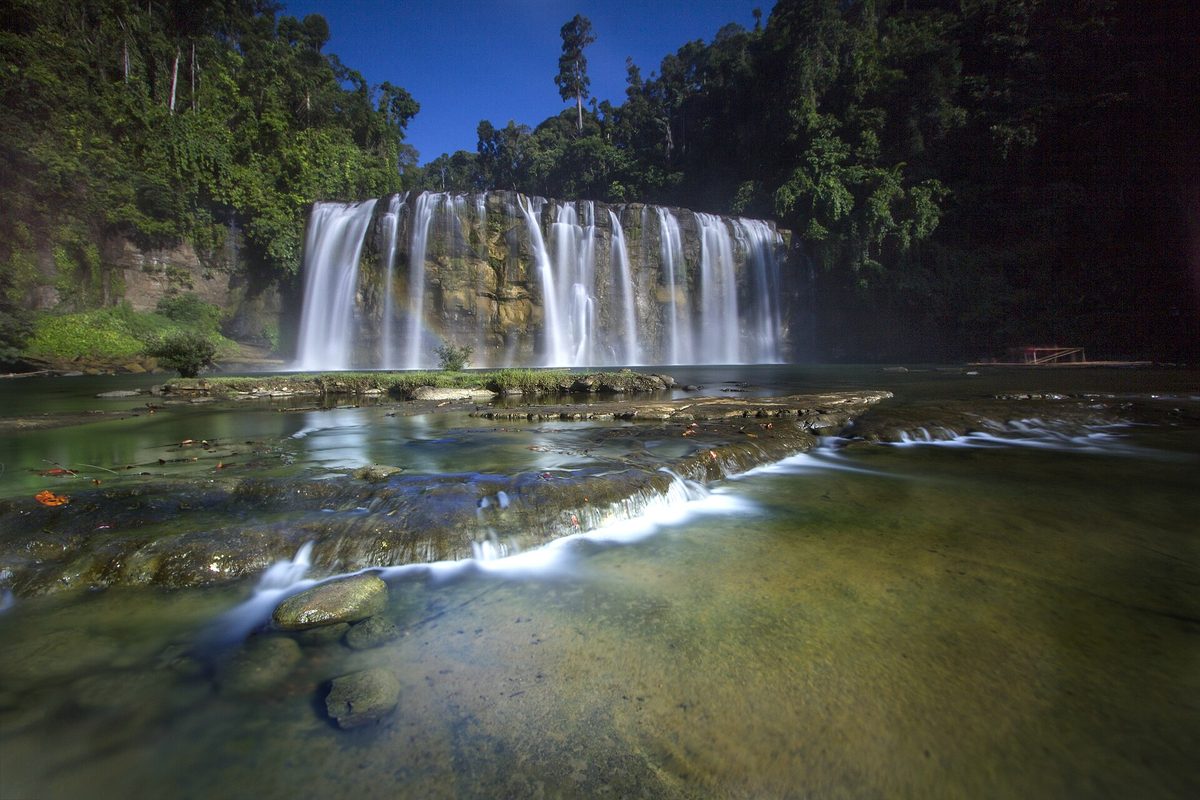
If Tinago is about depth, Tinuy-an is about width. Outside Bislig, three tiers of water spread roughly 95 meters across a mossy rock face in a near-continuous white curtain — the reason it gets called the Philippines’ little Niagara. On a sunny mid-morning a rainbow hangs in the spray almost on schedule, and a bamboo raft will pull you right up to the base to take the falling water on your shoulders. Entry is about PHP 50 ($0.90), parking PHP 10–20, and a life vest rents for around PHP 30 if you want to swim.
How to get there: this is the committing one. Fly into Davao, Butuan, or Surigao City, take a van or bus to Bislig (several hours), then a habal-habal from the Mangagoy district out to the falls for a negotiated PHP 100–400 round trip. Many people combine it with Hinatuan’s sapphire-blue Enchanted River nearby.
Best season: Tinuy-an is widest and most powerful in the wet season, but the access roads are roughest then too. Dry-season visits trade a little flow for an easier journey and clearer water for swimming.
Worth it / skip if: worth it if you are already exploring Surigao del Sur or Mindanao’s east coast — it is the most impressive wall of water in the country. Skip it as a standalone trip from elsewhere; the travel time only makes sense bundled with the Enchanted River and the region’s surf and dive spots, the sort of pairing our guide to surfing in the Philippines maps out for nearby Siargao.
Aliwagwag Falls, Davao Oriental — the stairway to heaven
Aliwagwag, near Cateel, is the giant: a staircase of roughly 84 to 130 connected tiers (counts vary) tumbling some 340 meters down a forested mountainside, the tallest single waterfall system in the country. The lower section is set up as an eco-park with viewing decks, a hanging bridge, and a swimming area, so you get the spectacle without a brutal trek. Entry is around PHP 100 ($1.70).
How to get there: from Davao City, take a bus or van toward Cateel (around five to six hours), then a tricycle or jeepney the final 13 kilometers to the eco-park. It pairs well with the white-sand beaches of the Davao Oriental coast.
Best season: dry season for the roads and the swimming area; the cascade is fuller after rain but the upper tiers can turn muddy.
Worth it / skip if: worth it if you are touring far eastern Mindanao — the tiered cascade is unlike anything else here. Skip it as a quick detour; Cateel is remote, and you want a night nearby rather than a same-day dash.
Asik-Asik Falls, North Cotabato — water from a wall of ferns
Asik-Asik is the strangest waterfall in the Philippines, and one of the most beautiful. There is no river feeding it from above — instead, spring water seeps straight out of a 60-meter cliff densely curtained in ferns and moss, so the whole green wall appears to weep dozens of separate silver streams into the valley. It went viral precisely because it does not look real. The fee is PHP 40–70 ($0.70–1.20) depending on where you are traveling from.
How to get there: this is a genuine expedition. From Davao or Cotabato City you drive a long way to Alamada, then take a habal-habal on a bumpy hour-and-a-half ride to the viewpoint, followed by a steep staircase down to the base. Going with a local guide or tour is sensible given the remoteness.
Best season: because the water comes from groundwater rather than a surface river, Asik-Asik flows reliably year-round — one of the few falls here that does not fade in the dry season. The dry months simply make the rough access road kinder.
Worth it / skip if: worth it for the genuinely once-in-a-trip sight if you have the time and tolerance for a long, rough journey. Skip it if you are short on days or unwilling to commit most of one to travel.
Luzon: A Canoe Run and an Easy Northern Walk
The big island gets overlooked for waterfalls because its headline acts are volcanoes and rice terraces. But Luzon hides two falls worth planning around: one a genuine adrenaline ride within reach of Manila, the other the gentlest trek on this whole list.

Pagsanjan Falls, Laguna — shooting the rapids by dugout canoe
Pagsanjan (locally Magdapio) is less about the waterfall than the journey to it, and that journey is a thrill. Two boatmen paddle and haul a narrow dugout canoe up the river, muscling it through fourteen sets of rapids in a dramatic gorge until you reach the falls, where a bamboo raft pulls you under the cascade and into the cave behind it. Then comes the payoff: the boatmen ride the rapids back down, the canoe bucking and spinning through the white water. It is a genuine workout for them, so tip generously — their effort is the whole experience. The round-trip boat run is around PHP 1,350 ($23) per person, plus a small PHP 50–100 entry; rates climb on weekends and through tour operators.
How to get there: from Manila, buses run to Pagsanjan and nearby Santa Cruz or Cavinti in roughly two and a half hours; the upper Cavinti launch point is the calmer, less hawker-heavy approach. It is one of the few falls on this list you can do as a day trip from the capital.
Best season: the canoe run requires safe water levels, so the dry season (December–May) is the reliable window. The river is closed or unsafe during and after heavy rain, and flash flooding is a real risk in the gorge — never push a wet-season run.
Worth it / skip if: worth it for the rapids ride, which is genuinely exciting and historic (it featured in Apocalypse Now). Be ready to firmly but politely negotiate fees and tips up front, as the spot has a long-standing reputation for hard-selling. If you have come to Luzon mainly for the highlands, our guide to the best time to visit the Philippines will help you line up the dry-season window when both the falls and the terraces are at their best.
Kabigan Falls, Ilocos Norte — the easy one up north
Way up in Pagudpud, near the surf and the windmills of the far northwest, Kabigan is the antidote to every step-count-from-hell on this list. A flat, pretty 20-to-30-minute walk through rice fields and light jungle leads to a single 30-meter drop into a calm, swimmable pool. It is the most family-friendly waterfall here, and the fee is almost nothing: PHP 20 ($0.35), with a local guide available for about PHP 100.
How to get there: from Laoag or Vigan, take a bus to Pagudpud, then a tricycle to the Kabigan trailhead; the walk in is well marked and gentle. It folds neatly into an Ilocos road trip alongside the heritage streets of Vigan and the Bangui windmills.
Best season: the trail can get muddy in the rains, so dry-season visits are more pleasant, though the falls themselves run year-round and are fuller after rain.
Worth it / skip if: worth it if you are already exploring Ilocos and want a low-effort nature break. Skip it as a destination in its own right — it is a lovely supporting act, not a headliner.
Waterfall Safety: Read This Before You Go
Waterfalls are the prettiest dangerous place in the Philippines, and most accidents are avoidable. A few rules I follow without exception:
- Flash floods are the real killer. Mountain rivers can rise in minutes from rain you cannot even see falling upstream. If the water is rising, turning brown, or carrying more debris, get out and get high immediately. Never enter a canyon or gorge (Kawasan, Pagsanjan, Tinago) when rain is forecast upstream, and trust operators who cancel — they are reading the river, not your itinerary.
- The rock is slipperier than it looks. Algae on wet limestone is treacherous. Wear water shoes or sturdy sandals with grip, never flip-flops on the climbs, and take the steps to Tinago, Casaroro, and Cambugahay slowly.
- Go with accredited guides. For canyoneering, cliff jumps, and the Aguinid climb, an accredited local guide is not optional — they know the safe jump depths, the current, and the exit routes. Check that the operator provides a helmet and life vest, and use them.
- Do not dive into unknown pools. Plunge basins hide rocks and shift depth after floods. Let a guide point out the safe jump spots, and lower yourself in feet-first if you are unsure.
- Mind your valuables and the timing. Bring a dry bag, carry small cash for fees and tips, and aim for the first slot of the morning — you beat both the crowds and the afternoon storm pattern.
Frequently Asked Questions
What is the most famous waterfall in the Philippines?
Kawasan Falls in Badian, Cebu, is the most famous and most visited, thanks to its triple-tier turquoise pools and the wildly popular canyoneering route that finishes there. Tinuy-an in Surigao del Sur (the “little Niagara”) and Pagsanjan in Laguna are the next best-known, but Kawasan is the one that draws thousands of visitors a day.
How much does it cost to visit waterfalls in the Philippines?
Most entrance fees are tiny: PHP 20–100 ($0.35–1.70) per person, often including a life jacket. The exceptions are activity-based: Kawasan canyoneering is about PHP 1,500 ($26) with guide and gear, and the Pagsanjan canoe run is roughly PHP 1,350 ($23). Budget a little extra everywhere for habal-habal transfers, parking, and tips for guides.
When is the best time to visit waterfalls in the Philippines?
It is a trade-off. Waterfalls are fullest and most powerful in and just after the rainy season (June–November), but the dry season (December–May) gives you safer rock, clearer turquoise pools, easier roads, and open canyoneering. For most travelers the dry season is the smarter choice; spring-fed Asik-Asik flows strongly all year regardless.
What are the best waterfalls near Cebu City?
The best waterfalls near Cebu are clustered along the south coast: Kawasan in Badian (turquoise pools and canyoneering), Tumalog in Oslob (a misty curtain), and the Samboan–Ginatilan group — Aguinid, Inambakan, Binalayan, and Dao. With a rented motorbike or hired driver you can chain three or four in a single day from a base in Moalboal.
Is Kawasan Falls worth it given the crowds?
Yes, with timing. The walk-in pools get packed by mid-morning in high season, so either arrive at opening (around 8am) or do the canyoneering route, which spends three to four hours in the gorge away from day-trippers and delivers you to the falls as a finale. Visited that way, Kawasan absolutely earns its reputation.
Are waterfalls in the Philippines safe to swim in?
Generally yes, in calm conditions and with a life vest where one is provided. The real dangers are flash floods after upstream rain, slippery rock on the descents, and diving into pools of unknown depth. Go with accredited guides for canyoneering and cliff jumps, heed any closure, and never enter a gorge when rain is forecast upriver.
Photo Credits
- Kawasan Falls, Badian, Cebu — public domain, via Wikimedia Commons
- Tumalog Falls, Oslob, Cebu — Iampjanz, CC BY-SA 4.0, via Wikimedia Commons
- Cambugahay Falls, Siquijor — Lawrence Ruiz, CC BY-SA 4.0, via Wikimedia Commons
- Tinago Falls, Iligan — CC BY-SA 4.0, via Wikimedia Commons
- Tinuy-an Falls, Bislig, Surigao del Sur — CC BY-SA 4.0, via Wikimedia Commons
- Pagsanjan Falls, Laguna — public domain (CC0), via Wikimedia Commons
Sources and Further Reading
- Philippine Department of Tourism — official travel portal
- Municipality of Alamada — official Asik-Asik Falls information
- PHIVOLCS — weather, seismic and flood-relevant advisories
- eTravel — the official Philippine arrival registration site
About this guide: PhilippinesTourism.org is an independent resource for planning Philippine travel. Fees and access verified June 2026 and reviewed quarterly — confirm current details before visiting.