Sugba Lagoon and Magpupungko Rock Pools
Two of Siargao’s most photographed day trips sit on opposite coasts and run on completely different rules. Sugba Lagoon is a calm, jade-green inlet near Del Carmen that you reach by boat through mangroves, while Magpupungko Rock Pools in Pilar are natural tidal pools that only appear at low tide. This guide covers both honestly: real 2026 costs, the tide trap, and whether they live up to the hype.
Sugba Lagoon and Magpupungko at a glance
If you only skim one thing, make it this. These are the numbers and logistics that actually change your plan, current as of 2026 (roughly 58 PHP to the US dollar).
| Spot | Side of island | Drive from General Luna | Tide-dependent? | Rough cost per person |
|---|---|---|---|---|
| Sugba Lagoon (Del Carmen) | Northwest | ~45–60 min to Del Carmen port, then ~15–30 min by boat | No (boat runs most of the day) | ~300–800 PHP (~$5–$14) depending on group size |
| Magpupungko Rock Pools (Pilar) | East | ~45 min–1.5 hr by motorbike | Yes — pools only form at low tide | ~50–100 PHP (~$1–$2) entrance, plus transport |
The headline takeaway: Sugba is flexible on timing but needs a boat, while Magpupungko is cheap and road-accessible but ruled by the tide chart. That single difference shapes how you fit them into a trip, which I get into near the end. First, where to find your Siargao bearings: this article is one of the day-trip pieces under our wider Siargao travel guide, and it pairs naturally with our overview of Siargao for non-surfers if waves are not your thing.
Sugba Lagoon: the calm jade inlet near Del Carmen
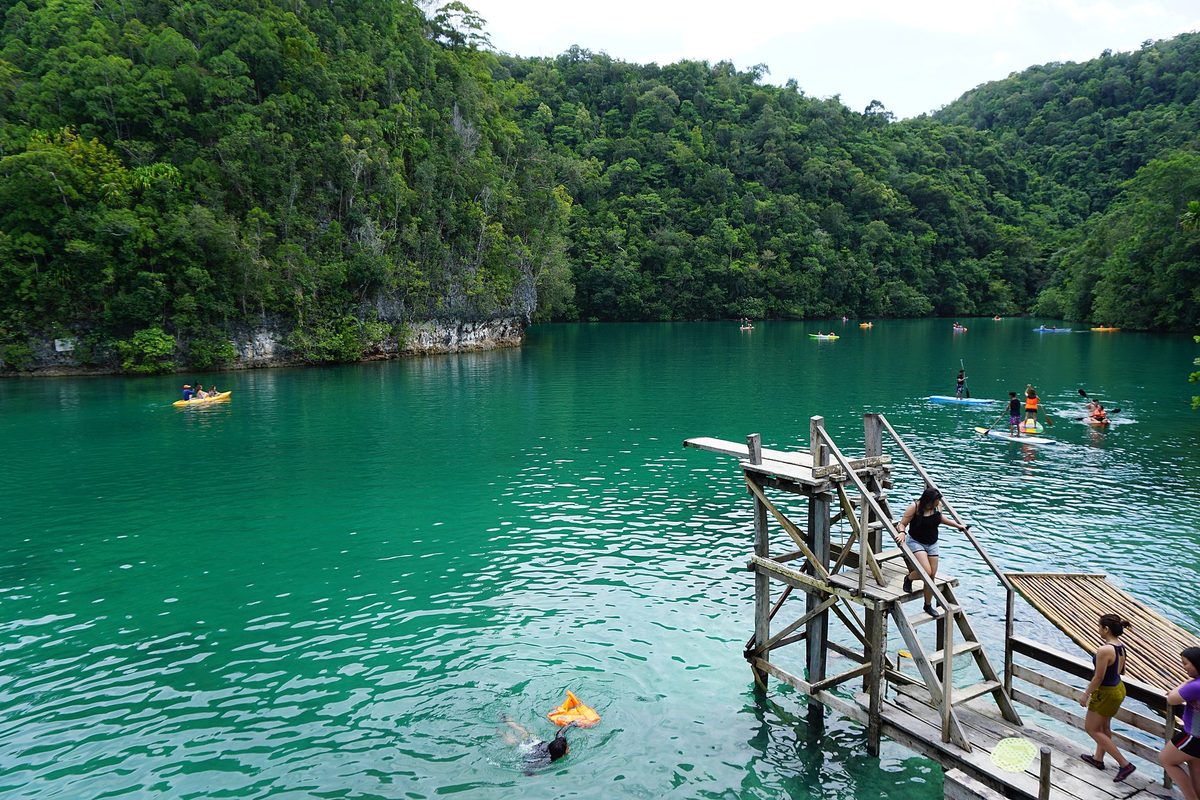
Sugba Lagoon sits on the Caob side of Del Carmen, the municipality that wraps the northwest corner of Siargao and protects the largest contiguous mangrove forest in the Philippines. The lagoon itself is a sheltered pocket of brackish, blue-green water rimmed by limestone karst and jungle. It is calm, deep enough to swim, and almost cinematically still on a windless morning. It feels a world away from the surf scene around General Luna and Cloud 9, which is exactly the point.
How to get to Sugba Lagoon
Everyone starts the same way: get yourself to Del Carmen port. From General Luna that drive is about 45 to 60 minutes across the island on Siargao’s famously smooth roads, either on a rented scooter or in a van if you have booked a tour. Del Carmen is the jump-off because Sugba is only reachable by boat. There is no road in.
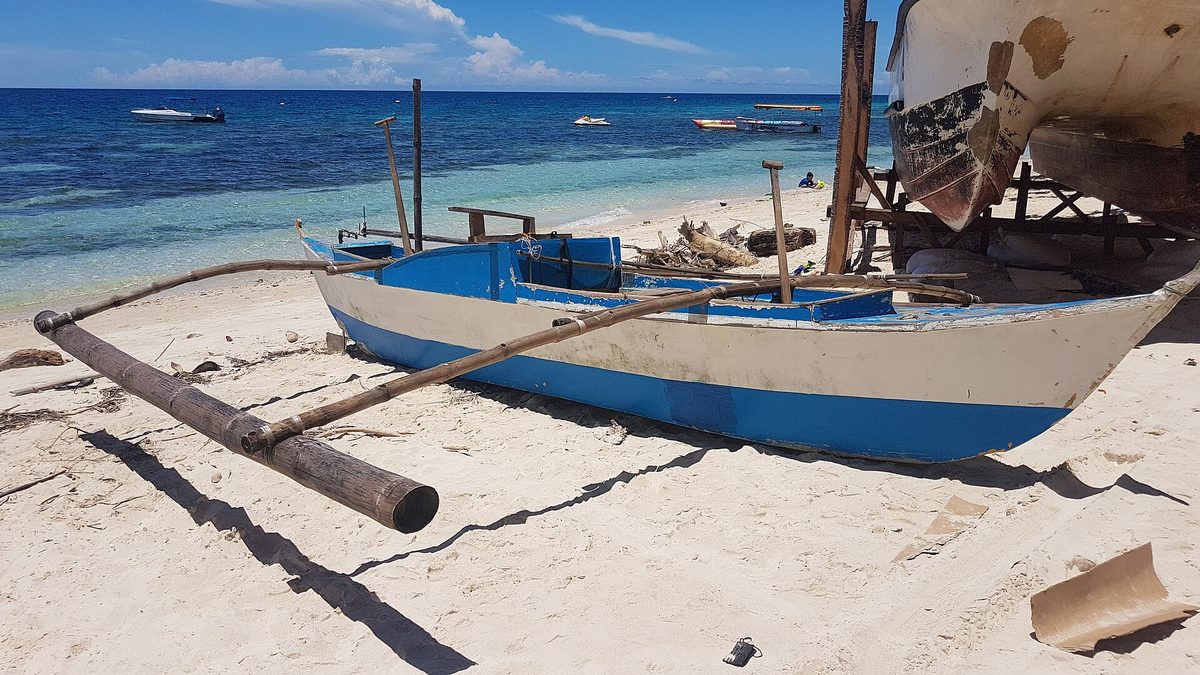
At the port you head to the tourism booth and arrange a boat. The standard outrigger (a bangka) carries up to about six passengers and the ride out takes roughly 15 to 30 minutes, weaving through mangrove channels before the lagoon opens up ahead of you. You will know you have arrived when you see the big “Welcome to Sugba Lagoon” sign at the mouth of the cove.
2026 boat, entrance and environmental fees
Sugba is not a single ticket; it is a stack of small fees. Here is the realistic 2026 breakdown. Treat every figure as “around,” because local rates drift and the peso moves.
- Boat rental (round trip from Del Carmen): around 2,150 PHP (~$37) for the whole boat, not per head. Split among six, that is roughly 360 PHP (~$6) each. Two of you pay the same total, so the cost per person swings hugely with group size.
- Entrance fee: around 100 PHP (~$1.70) for foreign visitors, about half that for locals.
- Environmental fee: around 50 PHP (~$0.85) per person.
- Terminal/port fee: around 20 PHP (~$0.35) per person.
- Extras at the lagoon: kayak rental around 300 PHP (~$5) for a regular one and up to 500 PHP (~$9) for a clear-bottom kayak; stand-up paddleboards and bamboo rafts in the 200–300 PHP (~$4–$5) per hour range; life jacket around 50 PHP; a table at the floating cottage around 50 PHP.
Add it up and a solo traveler or pair will spend roughly 700–1,000 PHP (~$12–$17) each once the boat is shared between just a few people, while a full boat of six can get the whole day down toward 400–600 PHP (~$7–$10) per person including one activity rental. If you are alone, ask at the booth or your hostel about joining another group to halve the boat cost. This is the single biggest lever on your budget.
Private boat versus join-in
You have two ways to do Sugba. A private boat you arrange yourself at the port gives you control over timing and which extra islands you tack on, and works out cheap if you fill the boat. A join-in or booked tour (sold by hostels, dive shops and online operators) bundles the hotel pickup in General Luna, the boat, fees and usually two nearby islands into one price, often somewhere around 1,500–2,500 PHP (~$26–$43) per person depending on inclusions. For solo travelers and couples a tour can actually be cheaper and far less hassle, since the boat cost is already spread across a group. For a group of four to six, do it yourself.
What to actually do at the lagoon
The star attraction is the wooden diving board and jump platform rising out of the water. There is usually a queue by mid-morning, so if leaping into clear water for the photo matters to you, be on the first boat out. Beyond the jump there is a floating cottage in the middle of the lagoon that doubles as a restaurant and a base for your bags; staff keep an eye on belongings while you swim. You can rent kayaks, clear-bottom kayaks, stand-up paddleboards and bamboo rafts and paddle into the quieter arms of the lagoon, or just float. The water is calm and there is no current to fight, which makes it genuinely relaxing rather than an adventure slog.
One practical limit: the floating cottage caps numbers, so there is often an unofficial three-hour window per group to keep boats rotating through. That is plenty of time to swim, paddle and eat, but it is why combining Sugba with a couple of islands on the same boat trip makes sense.
Best time of day and tide notes
Sugba is not strictly tide-locked the way Magpupungko is, so you can visit across most of the day. That said, early morning is the move. You get the calmest water, the best light, the diving board to yourself, and you beat the day-tripper crowds and the heat. By late morning multiple boats arrive at once. The water can look a touch less vivid at very low tide and the channels are easier to navigate when there is a bit more water in them, but honestly the difference is minor. Pick your start time around crowds, not the tide.
Combining Sugba with Kawhagan and Pansukian (Pamomoan)
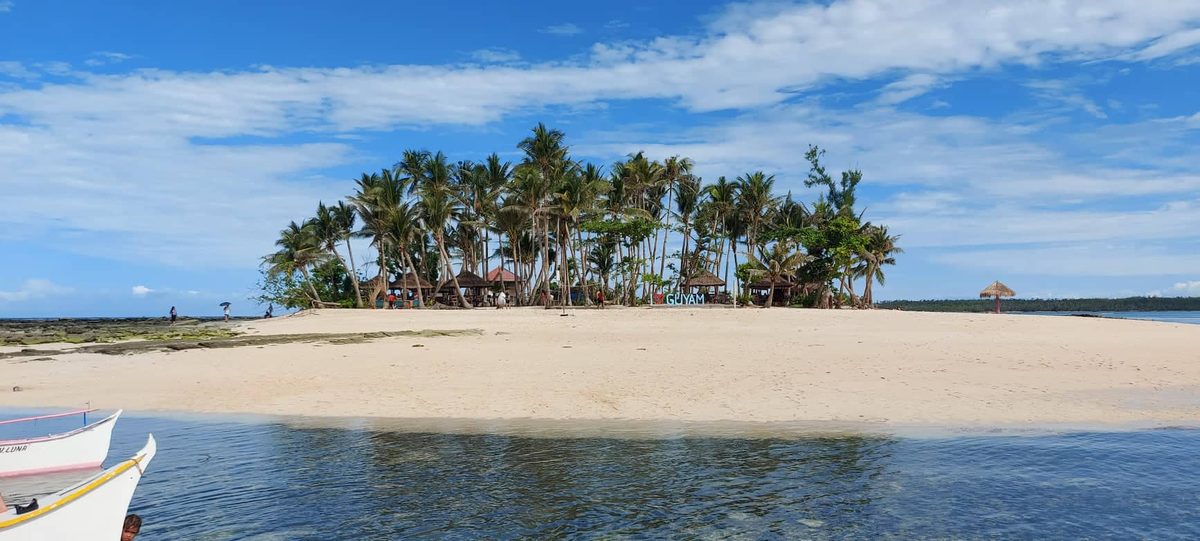
Because you have the boat for the day, most people pair Sugba with one or two islets on the same Del Carmen trip. Kawhagan Island is the classic add-on: a glittering white sandbar that is fully exposed at low tide, about 20 minutes by boat from the lagoon, with a small hut and a local kitchen serving grilled fish, pork adobo and rice for a few hundred pesos. Pamomoan (you will also see the nearby Pansukian/Naked-style sandbars marketed under various names) is the usual second stop, a quieter stretch of sand for a last swim before the run back to Del Carmen. This “Sugba plus two islands” loop is the standard full-day tour and the best value for the boat fee. If you want to go deeper on the wider archipelago, see our guide to Siargao island hopping.
Magpupungko Rock Pools: the tide-timed natural pools in Pilar
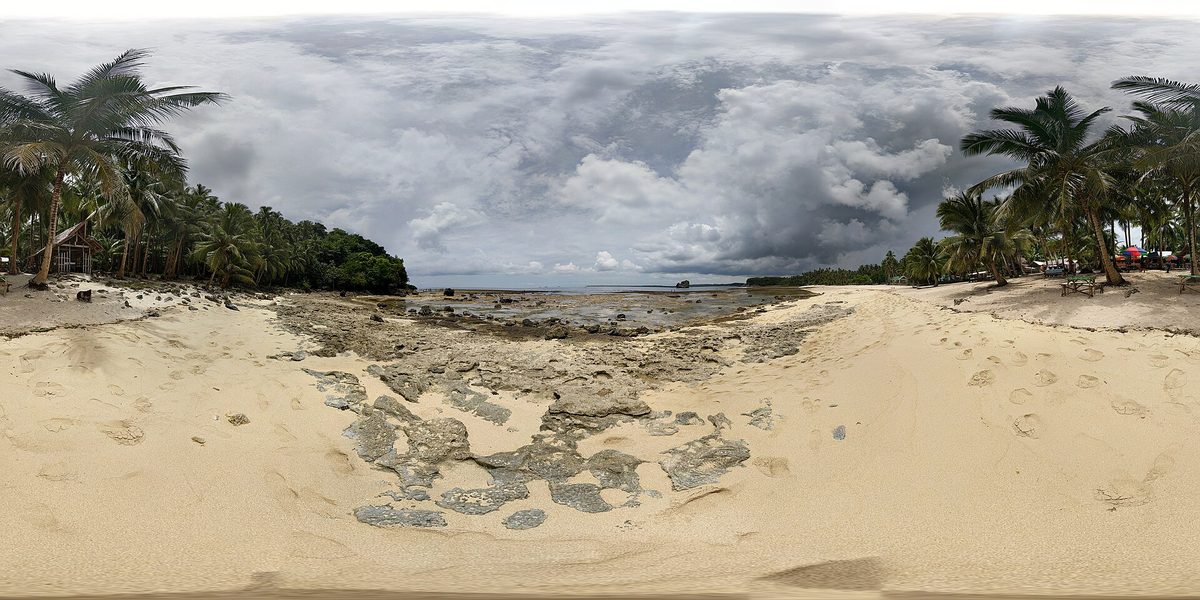
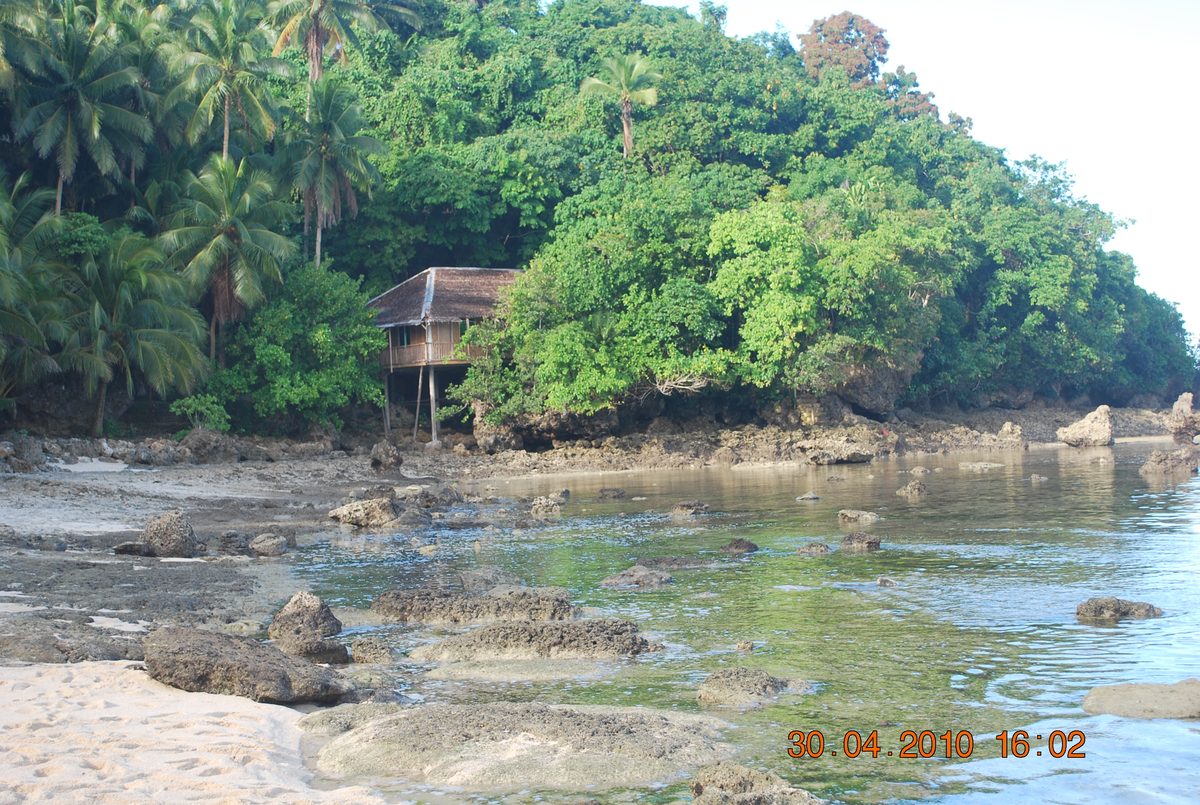
Magpupungko is the opposite kind of trip in almost every way. It is on the east coast in the municipality of Pilar, reached entirely by road, and it costs next to nothing to enter. The catch is that the thing you came to see does not exist for most of the day. The big natural tidal pool only forms when the sea retreats far enough to reveal the limestone basins; at high tide the whole area is simply submerged reef. Get the timing wrong and you have driven an hour to look at the ocean.
The name comes from the Visayan word pungko, “to squat,” after a large balancing rock that appears to sit on another near the pools. You will also see it spelled Magpopongko online; it is the same place.
The critical low-tide requirement (read this first)
This is the part people get wrong, so I am putting it bluntly: you must check the tide table before you go, and you must build your day around it. Magpupungko’s pools are tidal. They are exposed and swimmable at low tide and disappear at high tide. The tide swings roughly a meter between high and low here, and around the full and new moon the extremes are larger, which actually makes for better pools at the lowest point.
Aim to arrive about one to two hours before the day’s low tide, so conditions keep improving while you are there. You generally get a usable window of two to three hours on either side of the lowest point before the water creeps back and the guides close the pools for safety. Because the tide cycle shifts later by roughly an hour each day, yesterday’s good time is wrong today. Check a current daily tide chart for Port Pilar (Siargao Island) on a service like Tideschart, and cross-check the official forecasts from PAGASA, the national weather and tide authority. Note the time of low tide, subtract an hour or two for your arrival, then work backward to figure out when to leave General Luna.
Getting there: the drive and what is on the way
From General Luna the ride to Magpupungko is about 45 minutes to an hour on a scooter, which you can rent on the island for around 500–750 PHP (~$9–$13) a day. The roads are smooth and the drive is genuinely lovely, threading through coconut plantations and small barangays. The honest planning note is to give yourself 1.5 to 2 hours door to door if you intend to stop, because the route is dotted with worthwhile detours: the Maasin River coconut tree, the Tayangban Cave Pool near Pilar, the Coconut (Palm) viewpoint, and various roadside stands. Factor those stops into your tide math so you still hit the pools at the right moment. If you would rather not drive, a private or shared land tour covers Magpupungko plus several of these stops and handles the timing for you.
Entrance fee and the local guide
Entry is cheap: around 50 to 100 PHP (~$1–$2) per person, which also gets you the beach, plus a small parking fee for your motorbike. The fee is collected by the local community that manages the site. Near the pools you can hire a local guide for a modest tip; it is not mandatory, but a guide knows which pools are deep enough to jump into, where the current pulls, and the safe lines across the rocks, which is worth it if you plan to cliff jump.
Cliff jumping, swimming and the balancing rock
Once you are out on the rock shelf, Magpupungko is a playground. Several rock formations serve as natural diving platforms, with jumps in the 3 to 5 meter (10 to 16 foot) range, and the designated jump pools stay well over 3 meters deep even at low tide, so you are not going to clip the bottom where jumping is allowed. Always check depth and ask a local before you leap into an unfamiliar pool. If heights are not your thing, the appeal is just as strong: clear, calm basins for swimming and snorkeling, small caves and ledges to explore, and that iconic balancing rock perched on the reef around the corner. Bring a snorkel; little fish shelter in the nooks, and a few shacks rent masks if you forgot yours.
Seaweed, algae and why you need footwear
Two honest warnings. First, the rocks are sharp limestone and frequently slick with algae and seaweed. Barefoot is a recipe for cut feet and a slip. Wear water shoes or reef booties, or at minimum a pair of grippy sandals you do not mind soaking. Second, depending on the season and tide there can be patches of seaweed and a slightly slippery green film on the lower rocks; it is harmless but it is not the sterile turquoise infinity pool some photos suggest. Manage your expectations and watch your footing.
Crowds and timing
Magpupungko gets busy because its good window is short and everyone is working from the same tide chart. Mornings are generally quieter and cooler; afternoons bring better light on the rocks but bigger crowds, especially when low tide lands midday on a weekend. If a tour bus crowd arrives, walk a little farther along the shelf to the quieter pools and the balancing rock. There is also a pleasant beach and a row of food stalls selling fresh coconuts, grilled food and Filipino plates for when the tide pushes you off the rocks.
How to combine Sugba Lagoon and Magpupungko
Here is the logistics reality nobody tells you up front: these two sit on opposite sides of Siargao. Sugba launches from Del Carmen in the northwest; Magpupungko is in Pilar on the east coast. They are not next door, and only one of them cares about the tide. That combination makes a single rushed day awkward, even though tours sell it.
The honest case for doing them separately
For most travelers I would do these as two separate half-days, and here is why. Magpupungko has to be timed to low tide, which might fall at 8am one day and 1pm three days later. Sugba is flexible. If you chain them on one day, you either compromise the Magpupungko window to fit the boat schedule, or you spend a big chunk of the day in transit crossing the island. Splitting them means you hit Magpupungko exactly at its best tide and give Sugba a relaxed morning of its own. On a three-or-four-day Siargao trip that is easy to arrange.
If you only have one day: the combo tour
That said, combo tours do exist and can work if your schedule is tight and the tide cooperates. The usual format is a morning boat to Sugba from Del Carmen, then a drive across to Magpupungko timed to arrive for an afternoon low tide, often with a Filipino lunch included. It is a long day and it only makes sense when the low-tide hour happens to land in the afternoon. Before you book a same-day combo, ask the operator point-blank what time low tide is on your date and whether the itinerary actually hits it. If they cannot answer, that tells you something.
Rent a motorbike or join a tour
To do it yourself, a motorbike is the key (around 500–750 PHP / ~$9–$13 a day), giving you freedom to leave for Magpupungko on the exact tide and to ride to Del Carmen on your own schedule for Sugba. If you are not comfortable on two wheels on unfamiliar roads, book a private or shared land tour for Magpupungko and a separate boat tour for Sugba; between them you will spend more than the DIY route but skip all the timing math. Whichever you choose, sort your transport plan before you sort the sightseeing, the same way you would for any Siargao day out covered in our roundup of things to do in Siargao.
Are Sugba Lagoon and Magpupungko worth it, or overrated?
Straight answer: Sugba Lagoon is worth it for almost everyone; Magpupungko is worth it only if you nail the tide.
Sugba earns its reputation. The water really is that green, the setting is calm and beautiful, the diving board is fun, and bundling it with Kawhagan and a second sandbar makes a complete, low-stress day on the water for a fair price once the boat is shared. The only people who might shrug are those who have already done a lot of Southeast Asian lagoons; it is gorgeous but it is a lagoon, not a revelation. If you have time for one boat day that is not strictly about surfing, this is a strong pick, and it complements the calmer water you will find snorkeling in the Philippines elsewhere on a trip.
Magpupungko is more conditional. Hit it within a couple of hours of a good low tide and it is one of the most memorable spots on the island: clear natural pools, cliff jumps, the balancing rock, a nice beach to finish. Show up at high tide and you have paid to look at submerged reef, which is where the “overrated” complaints come from. It is not the place’s fault; it is a timing failure. Respect the tide chart and it delivers. Ignore it and you will be disappointed. For more on planning around Siargao’s seasons and conditions generally, see our notes on the best time to visit Siargao.
Frequently asked questions
Do I really need to check the tide for Magpupungko Rock Pools?
Yes, absolutely. Magpupungko’s pools only appear at low tide and are fully submerged at high tide, so the tide table is the single most important thing to check. Aim to arrive one to two hours before low tide for a two-to-three-hour window. Check a current daily forecast for Port Pilar on a tide-chart service and cross-reference PAGASA. Sugba Lagoon, by contrast, can be visited across most of the day.
How much does it cost to visit Sugba Lagoon in 2026?
Budget around 700–1,000 PHP (~$12–$17) per person if you are solo or a pair, or roughly 400–600 PHP (~$7–$10) each in a full boat of six. That covers the shared boat (~2,150 PHP total), the ~100 PHP entrance, ~50 PHP environmental fee, ~20 PHP terminal fee, and one activity rental like a kayak. Booked tours with hotel pickup and two islands typically run higher per head but spread the boat cost for you.
Can I visit Sugba Lagoon and Magpupungko in the same day?
You can, and combo tours sell it, but they sit on opposite sides of the island and only Magpupungko is tide-dependent. A same-day trip only works smoothly when low tide falls in the afternoon, letting you do Sugba in the morning first. Most travelers get a better experience splitting them into two separate half-days so Magpupungko can be timed precisely to low tide.
How do I get to Sugba Lagoon from General Luna?
Drive about 45 to 60 minutes to Del Carmen port, by rented scooter or tour van, then take an outrigger boat 15 to 30 minutes through the mangroves into the lagoon. There is no road into Sugba itself, so the boat is mandatory. At the port, arrange your boat and pay the fees at the tourism booth, or join an organized tour that handles pickup and the boat.
Is cliff jumping at Magpupungko safe?
The designated jump pools stay over three meters deep even at low tide, and jumps run roughly 3 to 5 meters, so they are safe when you use the marked spots. The risks are sharp, algae-covered rocks and jumping into the wrong pool. Wear water shoes, ask a local guide which pools are deep enough, and never jump into water you have not checked. If in doubt, skip the jump and enjoy the swimming.
What should I bring to these day trips?
For both: reef-safe sunscreen, water, a dry bag, and a way to secure valuables. For Magpupungko specifically, water shoes are close to essential for the sharp rocks, and a snorkel is worth packing. For Sugba, bring cash for the layered fees and rentals since there are no card machines, and budget for a kayak or paddleboard if you want to explore the quieter arms of the lagoon.
Sources and photo credits
Photo credits
- Sugba Lagoon diving board — Lucky Ambago Purok Otso / CC BY-SA 4.0 via Wikimedia Commons
- Traditional bangka outrigger boat — Obsidian Soul / CC0 via Wikimedia Commons
- Magpupungko low-tide rock flats — theinstantmatrix / CC0 via Wikimedia Commons
- Magpupungko shoreline cottage at low tide — kbraner / CC BY-SA 3.0 via Wikimedia Commons (Panoramio)
- Guyam Island sandbar — Azposse / CC BY-SA 4.0 via Wikimedia Commons
- Siargao pier at sunset — Billy Palatino / CC BY-SA 4.0 via Wikimedia Commons
Sources
- PAGASA — Philippine Atmospheric, Geophysical and Astronomical Services Administration, tide predictions
- Tideschart — daily tide forecast for Port Pilar (Siargao Island)
- Municipality of Del Carmen, Surigao del Norte (official site)
- Surigao del Norte Provincial Tourism
About this guide: PhilippinesTourism.org is an independent Philippines travel resource. Prices and schedules were verified June 2026; confirm current details before you travel.