Diving Moalboal: Sardine Run and Pescador Island
Moalboal is the rare dive town where the headline act sits 20 metres off the beach: a year-round wall of sardines you can reach in a snorkel. Add the vertical walls and the Cathedral cavern at nearby Pescador Island, resident turtles, and a strip of budget-friendly dive shops, and you have one of the most accessible serious dive bases in the Philippines.
I have dived a lot of the central Visayas, and Moalboal is the place I send people who want a big spectacle without a liveaboard or a 5am alarm. The sardine run alone is worth the three-hour ride from Cebu City. But it is not a flawless paradise, and the shallow reef in particular has a recent scar I will be honest about below.
Moalboal at a glance: the dive sites that matter
Here is how the main sites stack up. Depths and levels are typical ranges; conditions shift with tide and season, so treat your dive guide’s call as final.
| Dive site | Highlight | Depth | Level | Boat or shore |
|---|---|---|---|---|
| Panagsama / sardine run | Millions of sardines, baitball, turtles | ~5–20 m | All / snorkel | Shore |
| Pescador Island (Cathedral) | Wall, chimney cavern, white-tips | ~10–35 m | Open Water+ | Boat (~15 min) |
| Pescador East | Turtle hotspot, macro, coral heads | ~5–30 m+ | Open Water+ | Boat |
| Tongo Point | Wall, soft coral, schooling fish | ~5–30 m | Open Water+ | Boat / shore |
| Talisay (Turtle) Point | Reliable turtles on the slope | ~5–25 m | All | Shore / boat |
| Sunken Island | Offshore seamount, current, pelagics | ~18–40 m | Advanced | Boat |
Prices in this guide are 2026 estimates in Philippine pesos with rough US dollar conversions at about 58 PHP to the dollar. Dive shops adjust rates and fees change, so confirm the day’s numbers before you commit.
The sardine run: Moalboal’s headline act
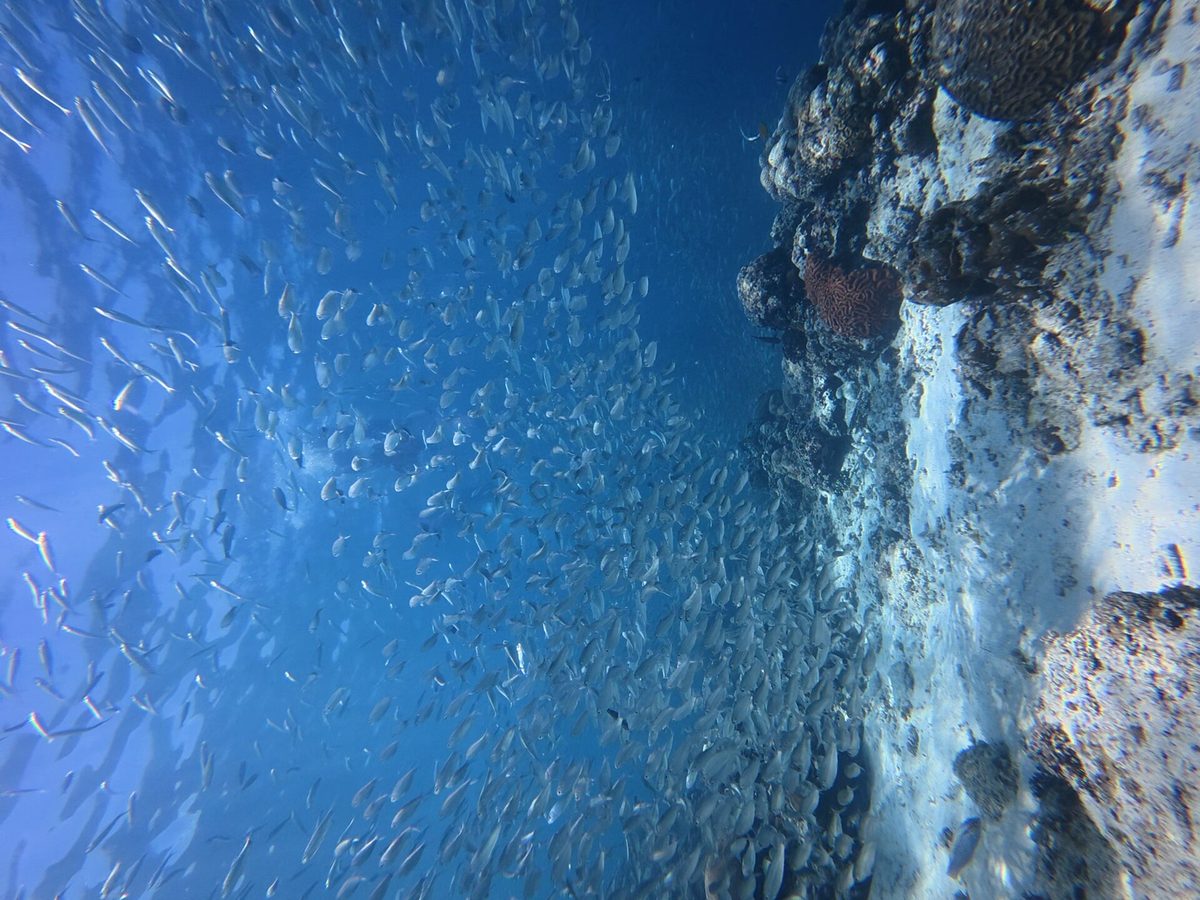
The sardine run is the reason most people come, and it earns the hype. A baitball of (by the usual estimate) more than a million sardines hangs just off Panagsama Beach, swirling and folding into shifting black curtains as predators and snorkellers push through it. Unlike a lot of “phenomena” in travel writing, this one is genuinely reliable: the sardines do not migrate away, and the run is present year-round.
What surprises first-timers is how shallow it is. The school typically sits between about 5 and 15 metres, and on a good day the top of it is only a few metres down. You do not need a tank to see it. From the Panagsama shore you swim out roughly 100 metres over the reef edge and the silver appears below you. I rate it as one of the best snorkelling experiences in the country, and it is the headline reason Moalboal shows up on lists of the best dive sites in the Philippines.
Snorkel, free-dive, or scuba
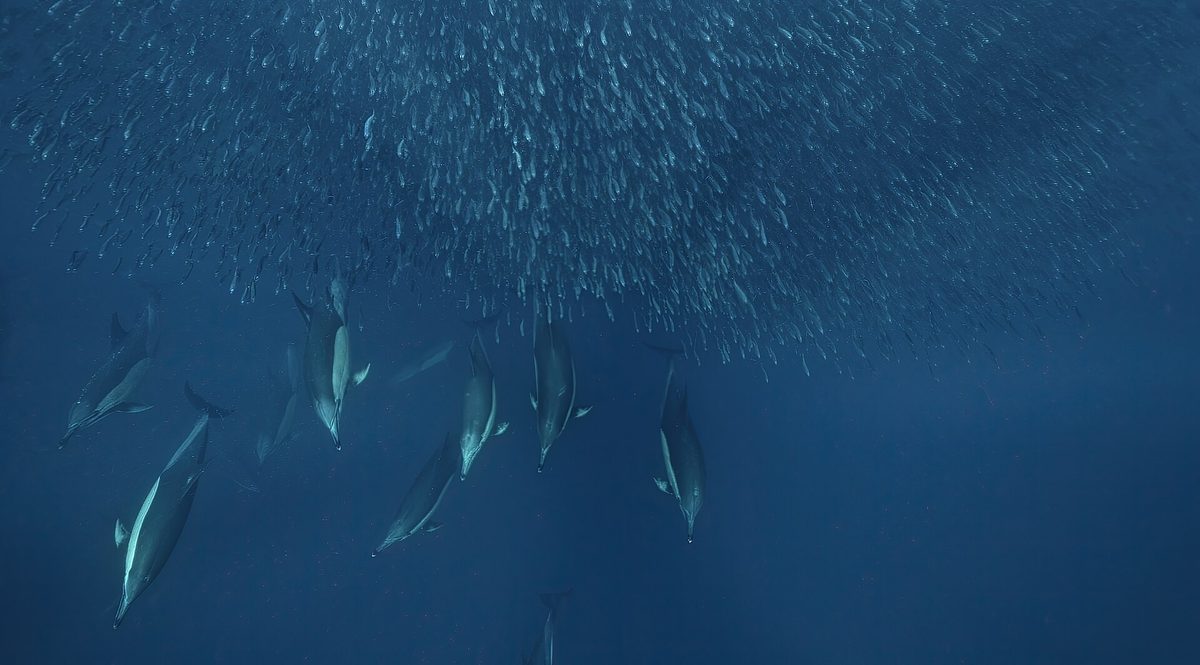
All three work, and the honest answer is that the difference is smaller than you would think. Because the baitball is so shallow, snorkellers floating on the surface get a genuinely good view, especially in the clear early-morning light. Free-divers get the magic shot: drop into the column and the sardines part and re-form around you, and that is the image you have seen online. Scuba lets you sit underneath the ball and watch the predators work it from below, but you also exhale bubbles that can push the school around.
My take: if you only do one thing, snorkel or free-dive the sardines and save your tanks for Pescador. If you are already diving, ask your shop to run the sardine run as a relaxed shore dive on the Panagsama wall and treat the school as a bonus rather than the whole point.
When and where to catch it
Go early. The window from about 6:00 to 8:00 am gives you the clearest water, the best light angling down through the school, and the fewest people in the frame. Later in the day the baitball is still there but the surface gets busy with island-hopping boats and the light flattens. The school lives on the reef wall directly off Panagsama Beach; any dive shop on the strip can point you to the exact entry, and several sit right on top of it.
Pescador Island and the Cathedral
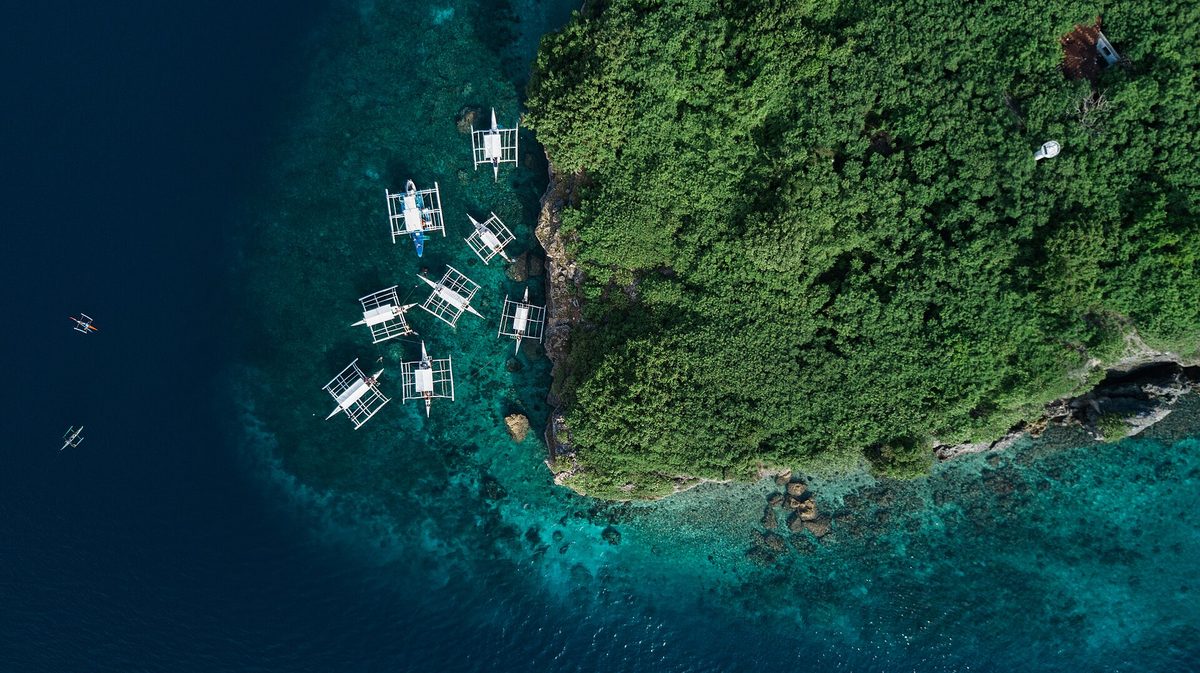
If the sardine run is Moalboal’s spectacle, Pescador Island is its proper dive. The island is a small, uninhabited limestone rock about 4 km west of Panagsama, roughly a 15-minute banca ride across the Tañon Strait. There is nothing above water: no beach, no shade, no landing. Everything worth seeing wraps around the island underwater, where a narrow reef plateau at 5 to 10 metres drops into vertical walls that plunge well past 60 metres into deep, cool, nutrient-rich water.
The signature feature is the Cathedral, a vertical chimney cavern on the island’s northwest side. You typically enter the opening around 28 metres and the shaft rises to roughly 16 metres, with sunlight pouring down through the chamber. It is the photograph everyone wants and a genuinely atmospheric swim-through. Because the entry sits at 28 metres, it sits right at the edge of recreational limits, so an Advanced certification (or a guide’s discretion) is the sensible call for the Cathedral and the deeper wall sections.
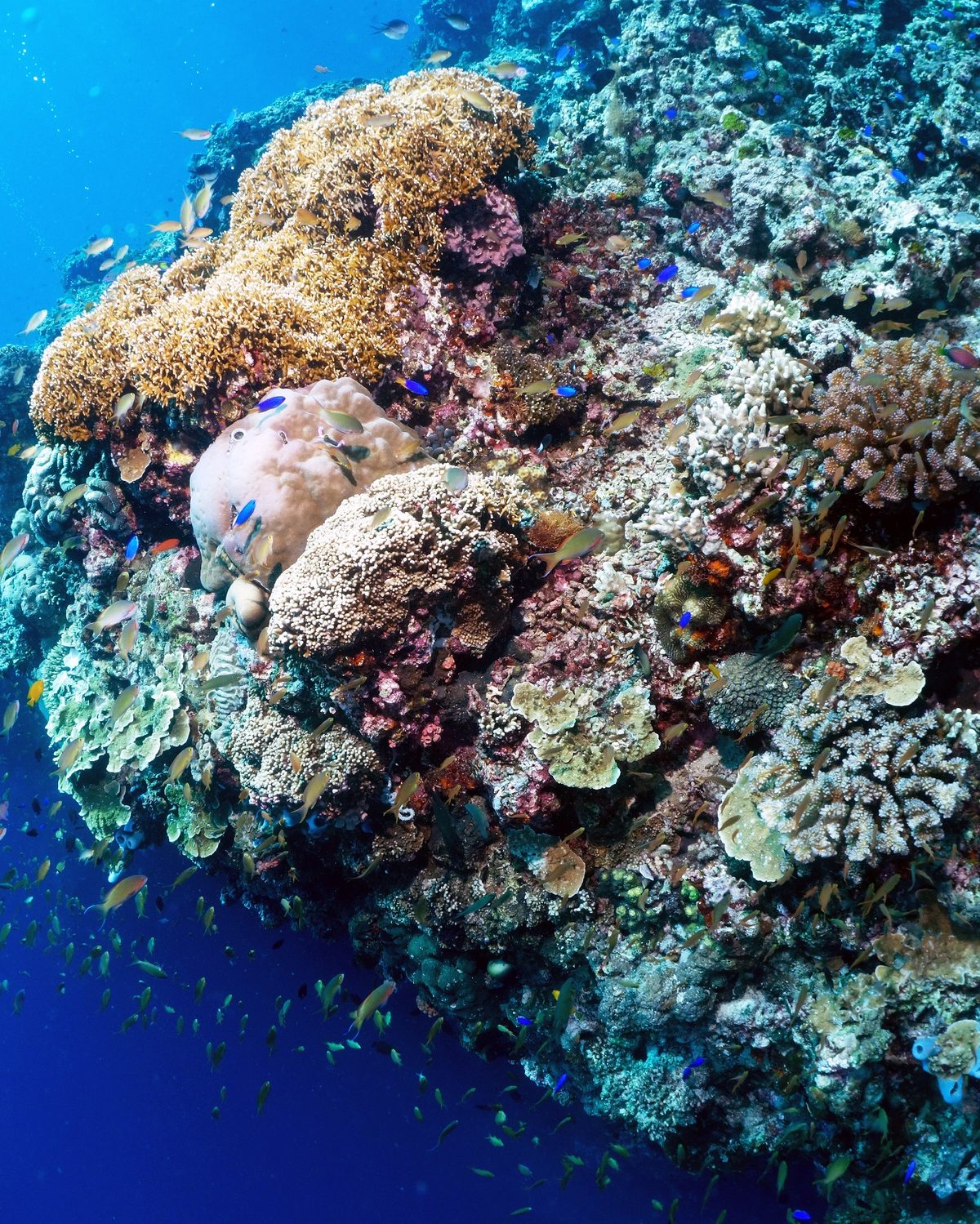
Around the rest of the island the walls are draped with soft corals, sea fans and sponges, and the marine life is dense. White-tip reef sharks show up reliably on the deeper sections, and Pescador has a real reputation for frogfish, so brief your guide that you want one and let them do the spotting. Visibility commonly runs 10 to 40 metres depending on the current, which usually flows south to north and makes for easy drift dives along the wall. You can cover most of the perimeter in two dives.
Pescador is a marine sanctuary, and the rules have teeth
Pescador is managed as a marine sanctuary under Moalboal’s municipal ordinance, within the wider Tañon Strait Protected Seascape. A marine park fee of around 100 PHP (roughly US$2) per dive is collected through your dive operator and goes toward sanctuary upkeep; note that it is charged per dive, not per day, so a two-tank trip means two fees. Most shops fold it into the dive price, but ask so you are not surprised.
Enforcement is real here. Bantay Dagat (the local sea wardens) patrol the sites, and a municipal ordinance carries a fine of around 2,500 PHP (about US$42) per person for touching or harming marine life, sardines and turtles included. Anchoring on the reef is banned, so boats use mooring buoys or sand. None of this should worry a careful diver, but do not reach out to touch a turtle for a photo.
The house reef and Panagsama wall
You do not need a boat to dive well in Moalboal. The house reef runs the length of Panagsama Beach as a sloping coral shelf that breaks at the top of a wall, and you can do it as an unguided shore dive (if your shop allows it) or a cheap guided one. The wall is where the sardine school lives, and it is also a steady producer of turtles, lionfish, scorpionfish and the usual reef community. It makes a perfect check-out dive on arrival or a relaxed last dive before your surface interval clears for travel.
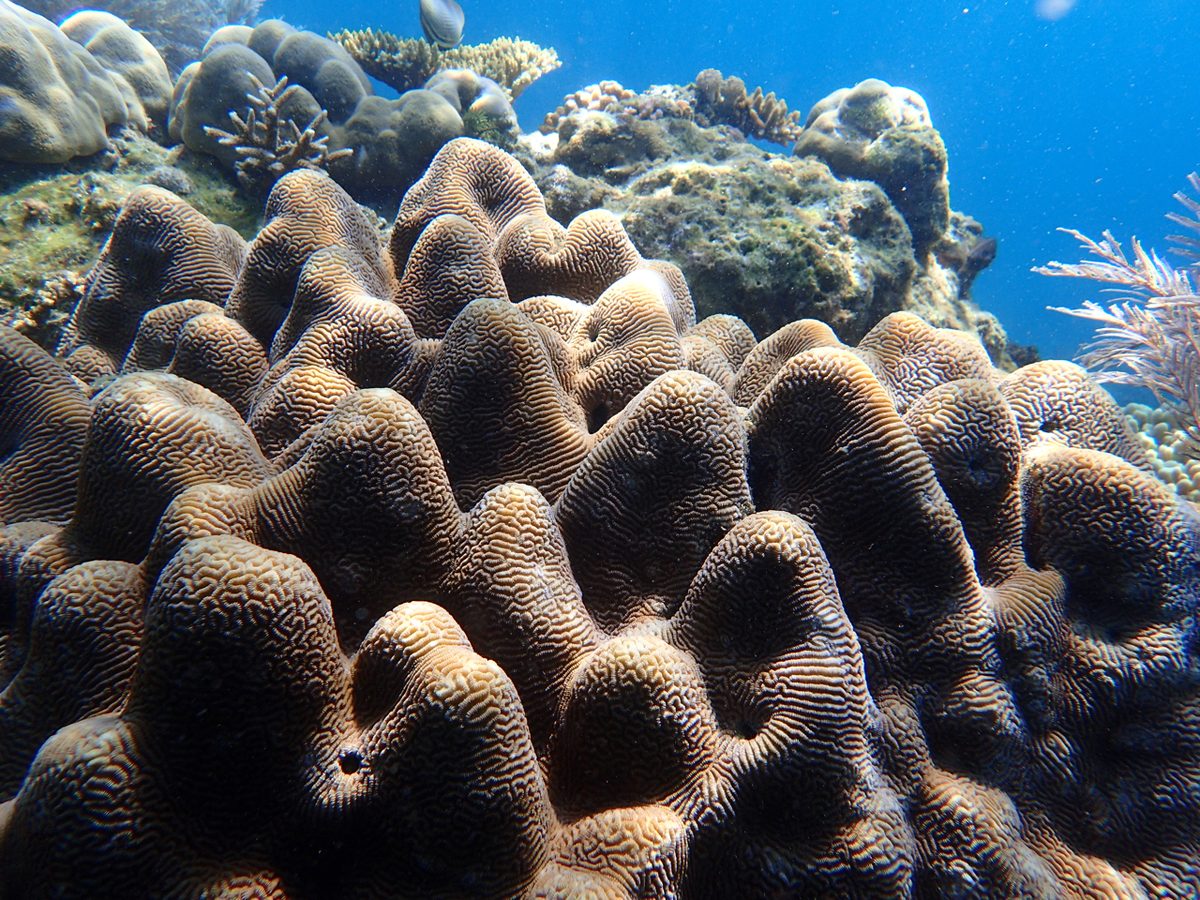
I will give you the honest picture of the reef itself, because the aggregator sites mostly skip it. In December 2021, Super Typhoon Odette (international name Rai) hit this coast hard. The deeper walls came through largely intact and still hold beautiful coral, which is why Pescador and the drop-offs are still excellent. But the shallow coral shelves down to around 10 metres were heavily scoured, and recovery there is slow and patchy. If you last dived Moalboal a decade ago, the shallow gardens are not what you remember. Coral-replanting programmes run by the provincial government and local dive operators are working on it, and the deeper diving remains genuinely good, but set your expectations for the shallows accordingly.
Turtles, and where to find them
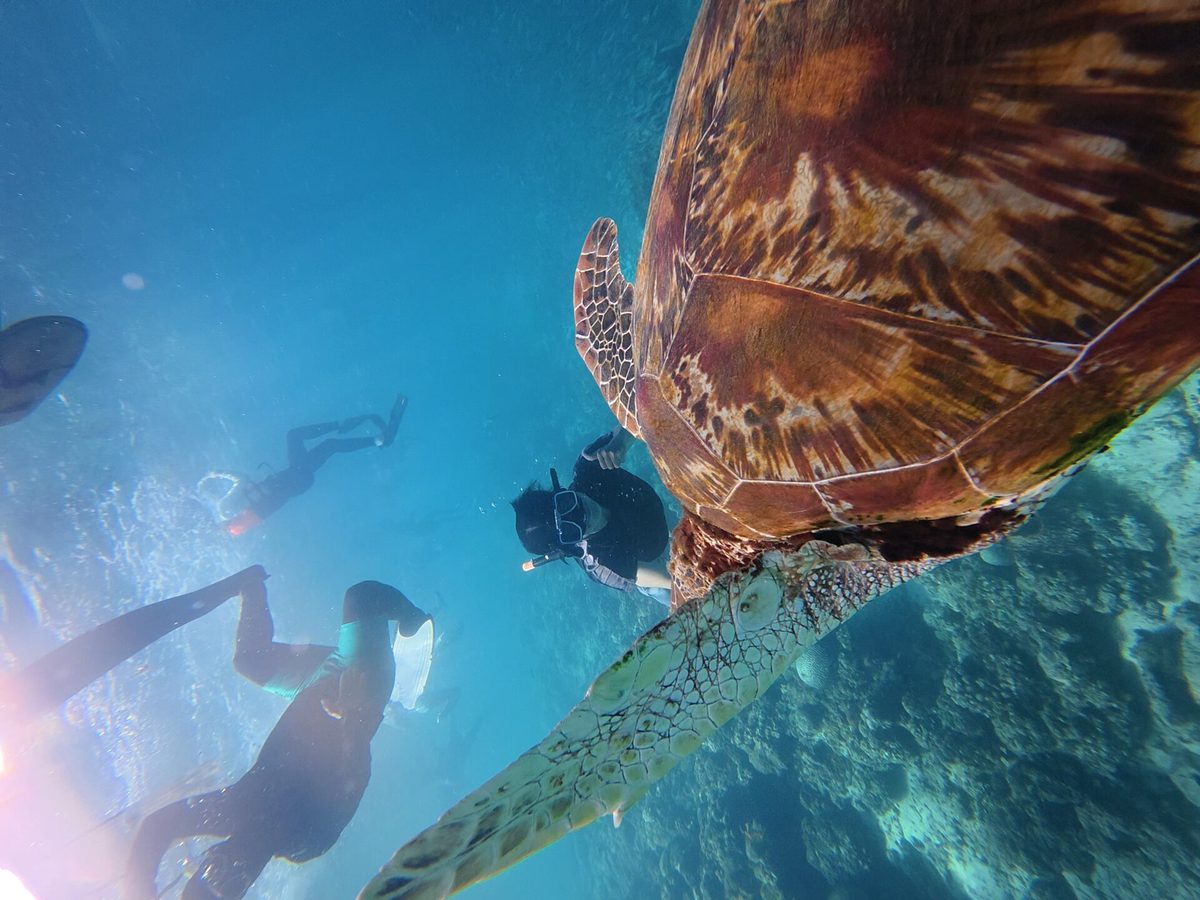
Green and hawksbill turtles are common in Moalboal, and you do not need to go far. Talisay Point (often just called Turtle Point) on the way toward town is the dependable spot; turtles graze the slope and are used to divers and snorkellers, so encounters are calm and close. They also turn up along the Panagsama wall and, frequently, at Pescador East, which has produced extraordinary counts on a single dive. Keep your distance, stay below or beside them rather than above, and do not chase. The same courtesy keeps turtle encounters good for the next group too. If turtles are high on your list, pair Moalboal with snorkelling in the Philippines elsewhere in the Visayas to stack your odds.
Other Moalboal dive sites worth your tanks
The peninsula has more than 15 established sites, and once you have done the sardines and Pescador, these round out a stay:
- Tongo Point: a pretty wall southwest of Panagsama with healthy soft coral, overhangs and schooling fish. Reachable by boat or, for the fit, a long shore swim.
- Talisay (Turtle) Point: the turtle banker, plus easy coral slope diving suitable for all levels.
- Sunken Island: an offshore seamount for advanced divers, with current and a better shot at pelagics. Conditions-dependent and not an everyday trip.
- Copton Point and the airplane wreck: a small sunk Cessna and reef south of the main strip, a fun change of scene on a multi-day stay.
None of these competes with Pescador for drama, but they spread your diving out and keep a three- or four-day trip varied.
Dive shops and prices: what Moalboal diving really costs
Moalboal is one of the better-value places to dive in the Philippines, and the dive shops cluster along the short Panagsama beachfront so you can walk in and compare. Established operators that run regular Pescador trips and courses include Savedra Dive Center, Cebu Fun Divers, Pescador Diving Center, Amigos (Diveinamigos) and Moalboal Dive Center, among others. Standards here are generally solid, but pick on the basis of group size, the boat, and how the briefing feels rather than on price alone.
Here is the realistic 2026 spread. Treat these as ballpark; shops adjust and high season firms prices up:
- Single fun dive: roughly 1,500–1,800 PHP (about US$26–31), usually including tank, weights, guide and the marine park fee.
- Two-tank Pescador trip: roughly 2,800–3,200 PHP (about US$48–55).
- Own full kit: expect around 5% off at most shops; rental gear is widely available if you travelled light.
- PADI Open Water course: roughly 18,000–22,000 PHP (about US$310–380), over three to four days.
- Marine park fee: around 100 PHP per dive at Pescador if it is billed separately.
Two practical notes. First, most dive centres are cash-only, and Moalboal’s ATMs are limited and can run dry in peak months, so withdraw enough in Cebu City before heading south. Second, dive insurance is sensible everywhere but matters here specifically: the nearest recompression chamber is in Cebu City, three to four hours away by road. For the bigger picture on costs and operators across the country, our pillar guide to scuba diving in the Philippines is the place to start.
Free-diving in Moalboal
Moalboal has quietly become one of the best free-diving bases in the Philippines, and the sardine run is the obvious draw. Several dedicated free-dive schools operate on Panagsama, running courses from beginner sessions through to deeper performance training, and the calm, deep water just off the beach is well suited to it. Even if you never take a course, the shallow baitball means a confident snorkeller with a single breath-hold can drop a few metres into the school and get the experience that makes free-divers out of people. If you have wanted to try it, this is a forgiving place to start.
Getting there and where to base yourself
Moalboal sits on the west coast of Cebu, facing Negros across the Tañon Strait, about a three-hour drive southwest of Cebu City. From Mactan-Cebu International Airport, take a taxi or Grab to the Cebu South Bus Terminal, then board a Ceres bus marked for Bato via Barili; air-conditioned fares run roughly 170–210 PHP and the ride is three to four hours depending on traffic. Tell the conductor you are getting off at Moalboal, then take a tricycle the last few kilometres down to Panagsama Beach for around 100–200 PHP. A private transfer from the airport runs roughly 2,500–3,500 PHP for the vehicle if you would rather not bus it.
Panagsama Beach is the dive hub and where I would stay, with the dive shops, restaurants and a relaxed, diver-focused strip all within walking distance. The neighbouring Basdiot area and the longer Basdako (White) Beach a few kilometres north give you more of an actual beach for non-diving afternoons. Accommodation spans backpacker dorms from around 1,500 PHP up to full-service dive resorts at 5,000 PHP and beyond. In high season, especially around Christmas, New Year and Easter, book ahead because the good rooms and boats fill. Moalboal slots neatly into a wider Cebu trip; see our Cebu travel guide and the dedicated Moalboal travel guide for the non-diving side of the town.
When to go
You can dive Moalboal year-round, and the sardines are always home. The dry Amihan season, roughly November to May, brings calmer seas and the best visibility, and it is prime time for the Pescador crossing. The Habagat months, roughly June to October, are warmer and wetter with afternoon storms and a higher chance the Pescador boat gets cancelled when the strait kicks up; mornings, though, are often still fine, and the town is quieter and cheaper. Because Moalboal sits in the sheltered Tañon Strait between two mountainous islands, it is better protected from monsoon wind than the exposed sites around Bohol, which is part of why it dives so consistently.
Honest take: who Moalboal is and isn’t for
Manage two expectations and you will love this place. First, the shallow reef. After Typhoon Odette the shallow coral is not pristine, so if you are picturing untouched gardens in two metres of water you will be let down; the magic here is the sardine baitball and the deeper walls, not the shallow shelf. Second, the crowds. Panagsama is compact and popular, and the sardine run draws snorkellers, free-divers and island-hopping boats all at once, so go early if you want it calm.
Who is it perfect for? Snorkellers and free-divers who want a world-class spectacle for the price of a beach fee. New and improving divers who want easy walls, reliable turtles and cheap, friendly shops. And anyone building a Visayas dive route who wants a low-stress base with great food and a short boat ride to a proper wall. If you are chasing pristine pelagic reef on the level of Tubbataha, that is a different (liveaboard) trip. And if your real wish is a giant-animal encounter, the Oslob whale sharks are a couple of hours south, though that is an ethically debated, provisioned experience worth reading up on first.
Diving Moalboal by experience level
One of Moalboal’s strengths is that it works across the certification ladder, as long as you match the site to the diver.
- Non-divers and snorkellers: the sardine run is the whole show, and a 100 PHP beach fee gets you in. Add a guide for around 300–500 PHP if you want a life jacket, gear and someone keeping an eye on you in the current.
- Beginners and Open Water divers: the house reef, Talisay turtles and the standard Pescador wall sit comfortably within your limits. Skip the Cathedral’s 28-metre entry until you have the depth ticket.
- Advanced divers: the Cathedral, the deep Pescador wall where the white-tips cruise, and Sunken Island’s current open up. This is also a sensible place to do your Advanced course, given the cheap rates.
- Free-divers: arguably the single best reason to come. The shallow baitball is made for breath-hold diving, and the schools on Panagsama will set you up for it.
Plan on three to five days to dive Pescador a couple of times, hit the sardines under different light, work in the turtle and wall sites, and still keep Moalboal’s slow pace. It also pairs well with Cebu beach days between dives if you want to slow the pace.
Moalboal dive FAQ
Is the Moalboal sardine run worth it?
Yes, and it is one of the few much-hyped sights that delivers. A baitball of over a million sardines sits a short swim off Panagsama Beach, shallow enough to snorkel, present year-round, and free to access beyond the small beach fee. Go between 6 and 8 am for the clearest water and the best light, and it is genuinely world-class.
Do you need to scuba dive to see the sardines, or can you snorkel?
You can absolutely snorkel it. The school usually hangs between about 5 and 15 metres, and on a good day the top is only a couple of metres down, so surface snorkellers get a great view. Free-divers get the dramatic shots by dropping into the column. Scuba lets you watch predators work the ball from below, but it is not required to enjoy the spectacle.
How much does diving in Moalboal cost in 2026?
Roughly 1,500–1,800 PHP (about US$26–31) for a single fun dive and around 2,800–3,200 PHP for a two-tank Pescador trip, usually including guide, gear and the marine park fee. A PADI Open Water course runs roughly 18,000–22,000 PHP. Bring cash; most shops do not take cards, and local ATMs are unreliable. Confirm current rates with the operator.
Is Moalboal still worth diving after Typhoon Odette?
Yes, with realistic expectations. The 2021 storm scoured the shallow reef down to around 10 metres, and recovery there is slow. But the deeper walls, Pescador Island and the Cathedral came through in good shape and still hold healthy coral, and the sardine run is unaffected. The headline diving is intact; the shallow gardens are the part still rebuilding.
How many days should I spend diving Moalboal?
Three to five days is the sweet spot. That gives you a couple of dives at Pescador, the sardine run under different conditions, the turtle and wall sites, and time to enjoy the town’s relaxed pace. Two nights is the bare minimum to cover Pescador plus a sardine-run dive; add days if you also want Kawasan Falls canyoneering nearby.
Do I need an advanced certification for Pescador Island?
Open Water certification covers most of Pescador at recreational depths. An Advanced Open Water cert is recommended for the Cathedral, which is entered around 28 metres, and for the deeper wall sections past 30 metres where white-tip reef sharks are most often seen. Many shops will tailor the dive to your level, so be honest about your experience and recent dives.
Sources and photo credits
Photo credits
- Sardine baitball off Panagsama Beach: Photo by Jhe098, CC BY-SA 4.0, via Wikimedia Commons.
- Sardines and dolphins underwater: Photo by Stanislav Stelmakhovich, CC0, via Wikimedia Commons.
- Reef wall at Pescador Island: Photo by pescadorescebu, CC BY-SA 4.0, via Wikimedia Commons.
- Green sea turtle with snorkellers, Moalboal: Photo by Jhe098, CC BY-SA 4.0, via Wikimedia Commons.
- Hard coral reef formations: Photo by Firth m, CC BY-SA 4.0, via Wikimedia Commons.
- Aerial of Pescador Island and dive boats: Photo by Ken Suarez, CC0, via Wikimedia Commons.
Sources
- Philippine Department of Tourism — official national tourism information.
- Tañon Strait Protected Seascape (DENR) — the protected seascape that includes Pescador Island.
- Philippine Dives: Pescador Island dive guide — dive-site detail, fees and operator pricing.
- Live Life The Philippines: Diving Moalboal — first-hand 2026 reef-recovery reporting.
About this guide: PhilippinesTourism.org is an independent Philippines travel resource. Routes, prices and dive-site conditions were verified October 2026; confirm current details with operators before you book.