Cebu and Bohol Itinerary: The Classic Visayas Combo
If you have one week in the Philippines and you want beaches, a real adventure, and animals you have never seen anywhere else, pair Cebu with Bohol. The two islands sit about 80 km apart in the central Visayas, linked by a fast ferry from Cebu Pier 1 to Tagbilaran that runs roughly every 30–45 minutes and takes about two hours. Cebu gives you canyoneering, a free wild sardine run, and turquoise reefs; Bohol gives you the Chocolate Hills, tarsiers, and the calm white sand of Panglao. It is the most popular first-timer combo in the country for good reason.
I have run this route three times now, twice with friends and once dragging my (slightly skeptical) parents along, and I have made most of the mistakes so you do not have to. This guide is the day-by-day plan I actually use: a flagship seven-day version and a tighter five-day one, with real transfers, where I sleep, hedged 2026 costs in pesos and dollars, and an honest take on the one stop everyone argues about. It sits inside our larger Philippines itinerary guide, so if you are stitching this onto Palawan or Siargao later, start there for the big picture.
The route at a glance
Here is the seven-day flagship laid out as a table. Fly into Mactan-Cebu (CEB), work down the Cebu coast, ferry across to Bohol, and — this is the part most blogs miss — fly home out of Bohol-Panglao (TAG) instead of backtracking. Costs below are per person, hedged for 2026 (roughly ₱58 = $1); verify current rates when you book.
| Day | Base | Highlights | Getting there |
|---|---|---|---|
| 1 | Cebu City | Magellan’s Cross, Basilica del Santo Niño, Sugbo Mercado street food | Land at Mactan-Cebu (CEB); taxi/Grab to city, ~30–45 min, ₱250–400 |
| 2 | Moalboal | Free sardine run + turtles off Panagsama Beach, sunset at the wall | Bus or van from Cebu South Bus Terminal, ~3 hrs, ₱150–500 |
| 3 | Moalboal | Kawasan Falls canyoneering, Pescador Island hop | Van/tricycle to Badian, ~40 min |
| 4 | Panglao (Bohol) | Travel day; afternoon on Alona Beach | Van back to Cebu City, ferry Pier 1→Tagbilaran (~2 hrs), van to Panglao (~45 min) |
| 5 | Panglao | Bohol countryside loop: Chocolate Hills, tarsiers, Loboc River lunch cruise | Private/joined day tour from Panglao, full day |
| 6 | Panglao | Balicasag or Virgin Island hopping, dolphins, beach day | Boat from Alona Beach, half day |
| 7 | Fly out | Slow morning, last swim | Fly home from Bohol-Panglao (TAG), ~20 min from Alona |
Why this order, and which way to fly
You can run this loop in either direction, but the open-jaw routing (into Cebu, out of Bohol) is the one I push hardest — it follows the same logic as the wider island hopping routes we map across the country: never backtrack, and finish where you fly out. Mactan-Cebu (CEB) is a true international hub with cheap, frequent flights from Manila, Singapore, Seoul, and beyond, so it is the natural arrival point. Once you have finished in Bohol, Bohol-Panglao International (TAG) sits a 20-minute drive from Alona Beach and now flies several times a day to Manila on Cebu Pacific, PAL Express, and AirAsia. Flying out of TAG saves you a two-hour ferry back to Cebu plus the city transfer on your departure day, which is exactly the kind of pointless backtrack that eats a holiday morning. If your international flight only connects through Cebu, just take a short CEB hop or the morning fast ferry back — but check the open-jaw option first.
One more sequencing note: I front-load Cebu because the canyoneering and the sardine run are the physical, early-start days, and I would rather end soft on a Panglao beach than start there and lose momentum. If you are weighing the two islands against each other before you commit, our Cebu vs Bohol breakdown lays out who each island suits.
Days 1–3: the Cebu side
Day 1: Cebu City, the historic core
Most people treat Cebu City as a place to get out of. I disagree, mildly. Give it one half-day. From the airport on Mactan Island, a Grab or metered taxi into the old centre takes 30–45 minutes (₱250–400, more in traffic, which is most of the time). Walk the compact historic cluster: Magellan’s Cross, planted in 1521 and now sheltered in a little kiosk; the Basilica Minore del Santo Niño next door, home to the country’s most venerated religious icon; and Fort San Pedro, the oldest triangular bastion fort in the country. It is an hour of walking, tops, and it grounds the whole trip in the fact that this is where European contact with the archipelago began.
For the evening, go to Sugbo Mercado (a night food market, busiest Thursday–Sunday) and eat lechon — Cebu’s roast suckling pig is the best in the Philippines and I will not be taking questions. Budget ₱300–600 ($5–10) for a big plate-sharing dinner. Sleep near IT Park or the Capitol area; mid-range hotels run ₱2,500–4,500 ($43–78). If you want to go deeper on the city and the rest of the province, our full Cebu guide covers it.

Day 2: south to Moalboal and the sardine run
Get to the Cebu South Bus Terminal early and take a Ceres bus or a van toward Moalboal — about three hours and only ₱150–500 ($3–9), the price gap being aircon bus versus a faster V-hire van. Moalboal is a scruffy, lovable little dive town, and its headline act is completely free.
The Moalboal sardine run is a permanent, year-round bait ball of millions of sardines that hangs just off Panagsama Beach, sometimes only 20–30 metres from shore in water shallow enough to free-dive. You do not need a boat or a tour. Walk down to the beach, wade in with a mask and snorkel, kick out a short way, and the silver wall is just there, twisting and folding around you while turtles graze on the seagrass below. Rent a mask for around ₱100–250 if you did not bring one. This is, genuinely, one of the best free wildlife experiences in Southeast Asia, and it is the centrepiece of my honest argument about Oslob further down.

Stay two nights in Moalboal. Hostels go for ₱500–900 ($9–16) a dorm bed; decent private rooms near Panagsama are ₱1,500–3,000 ($26–52). End the day at the reef wall for sunset.
Day 3: Kawasan Falls canyoneering and Pescador Island
This is the big adventure day, and it is worth every peso. Kawasan Falls canyoneering starts up in Badian, a 40-minute van or tricycle ride from Moalboal. You spend roughly three hours jumping off ledges (from gentle 3 m hops up to a heart-in-mouth 10–12 m if you choose), swimming through a gorge, and floating down a startlingly turquoise river to the falls themselves. The standard guided package runs about ₱2,000–2,500 ($34–43) including the mandatory guide, life vest, helmet, and the various local fees; book through your accommodation or a Moalboal operator rather than a random tout at the trailhead. If you only want to see the falls without the jumping, the plain entrance fee is around ₱200.
Important honesty: canyoneering is not risk-free. People have been injured and, in flash-flood conditions, killed here. Go with a licensed guide, do not do it after heavy upstream rain, and never let anyone pressure you off a jump you are not comfortable with. Done sensibly, it is the highlight of the whole Cebu side.

If you have an afternoon or you would rather a gentler day, swap in a Pescador Island boat hop from Panagsama instead (₱1,500–2,500 per small boat, split between your group). Pescador’s walls drop past 40 m and you will often see turtles, and sometimes thresher sharks on a deep dive. If you are a certified diver, this stretch of coast is reason enough to plan extra time on its own.
The Oslob whale shark question — my honest recommendation
Almost every Cebu–Bohol itinerary you will read routes you to Oslob, on Cebu’s far south-east coast, to swim with whale sharks at dawn. I am going to give you the straight version, because most blogs gloss over it and I think that does readers a disservice.
In Oslob, the whale sharks are fed. Local boatmen hand-feed them small shrimp every morning to keep them reliably in one small bay so tourists can pay to swim with them. That is what guarantees the sighting — and it is also the problem. Marine scientists and conservation bodies have raised consistent, serious objections. Reef-World and the UN Environment Programme’s Green Fins initiative have come out against the practice as unsustainable. Researchers have documented that the sharks learn to associate boats with food and change their natural movement and feeding behaviour; one widely quoted comparison likens their provisioned diet to a person living entirely on fast-food fries. There are also routine concerns about boats and swimmers crowding and occasionally striking the animals despite the official code of conduct.
Defenders point out, fairly, that tourism turned former whale-shark hunters into protectors and pumps real money into a poor municipality. It is not a cartoon of good versus evil. But weighing it honestly: I do not go to Oslob, and I would gently steer you away from it too. Feeding a wild, endangered, highly migratory animal to manufacture a photo op is a line I am not comfortable crossing, and you do not need to either — because Cebu hands you a better, free, genuinely wild alternative.
That alternative is the Moalboal sardine run you already did on Day 2: a wild, un-baited, year-round spectacle that costs nothing and harms nothing. If your heart is set specifically on whale sharks, the ethical move is to see them where they gather naturally and are not fed — for example on a responsible boat trip, or by building in a side trip to Donsol in Sorsogon (a separate, plankton-driven, non-feeding site) on a different leg of your Philippines trip. We get into the full debate, the science, and the better options in our dedicated guide to whale sharks at Oslob. If you still choose to go after reading all that, at least go informed.
Practically, skipping Oslob also tightens your route. It sits two-plus hours beyond Moalboal in the wrong direction for Bohol, so cutting it saves you the better part of a day and a lot of pre-dawn misery. Spend that time in the water at Panagsama instead.
Crossing from Cebu to Bohol: the ferry logistics
The water crossing is the spine of this trip, so let me be precise about it. Fast ferries leave from Cebu Pier 1 in Cebu City and arrive at Tagbilaran Port on Bohol. Two operators run the route: OceanJet and SuperCat. Between them, departures run frequently — on the order of every 30–60 minutes — from early morning (the first boats leave before 6am) until evening, and the crossing takes about two hours.
Fares in 2026 sit in the region of ₱800–1,200 ($14–21) on SuperCat and ₱1,000–1,560 ($17–27) on OceanJet, depending on tourist versus business class. Note that both operators added fuel surcharges in early 2026 and occasionally trim schedules, so treat these as ballpark and confirm the live fare when you book. There is usually a small terminal fee (around ₱25) paid at the pier. Children, seniors, and PWDs get a discount.
A few hard-won tips. Book the morning you are crossing or a day ahead online (both operators sell tickets through their sites and through Cebu travel desks); weekend boats and holidays fill up. Get to Pier 1 at least 45–60 minutes early, because you queue to check in, pay the terminal fee, and pass a bag scan. These are passenger-only fast craft — no cars — which is fine, since you do not want a car for this itinerary anyway; you will use vans, tricycles, and tours on both islands.
On the Bohol side, Tagbilaran Port to Panglao (where Alona Beach is) is a 30–45 minute drive; a van or taxi runs ₱400–800 ($7–14) for the car, or grab a cheaper shared van. Then you are on island time.
Days 4–7: the Bohol side
Day 4: travel day and Alona Beach
This is your transition. Van back from Moalboal to Cebu City (about three hours), then the fast ferry to Tagbilaran, then the short hop to Panglao. It is a moving day, so do not over-plan it. Aim for a late-morning or midday boat and you will be checking into your Panglao place by mid-afternoon with time for a swim. Alona Beach is the main strip: a curve of pale sand lined with dive shops, beach bars, and seafood grills. It is busier and more developed than Moalboal, and that is the point on a travel day — everything is walkable and easy.
Where to sleep on Panglao spans the full range. Hostel dorms start around ₱500–900 ($9–16); a clean budget room with a fan or basic aircon is ₱1,500–2,500 ($26–43); polished mid-range and beach resorts run ₱4,000–7,000 ($69–120); and the big names on the beach go well north of that. I usually stay a five-minute walk back from the sand, where prices drop sharply and the noise does too. The whole island is covered in our Bohol guide if you want to wander beyond Alona.

Day 5: the Bohol countryside loop
This is the day Bohol earns its reputation, and it is a packed one. The classic countryside tour stitches together the island’s greatest hits in a single full-day loop. You can join a shared tour, book a private car with driver-guide (₱2,500–3,500 / $43–60 for the car, split between your group), or hire a habal-habal motorbike for two. Highlights, roughly in order:
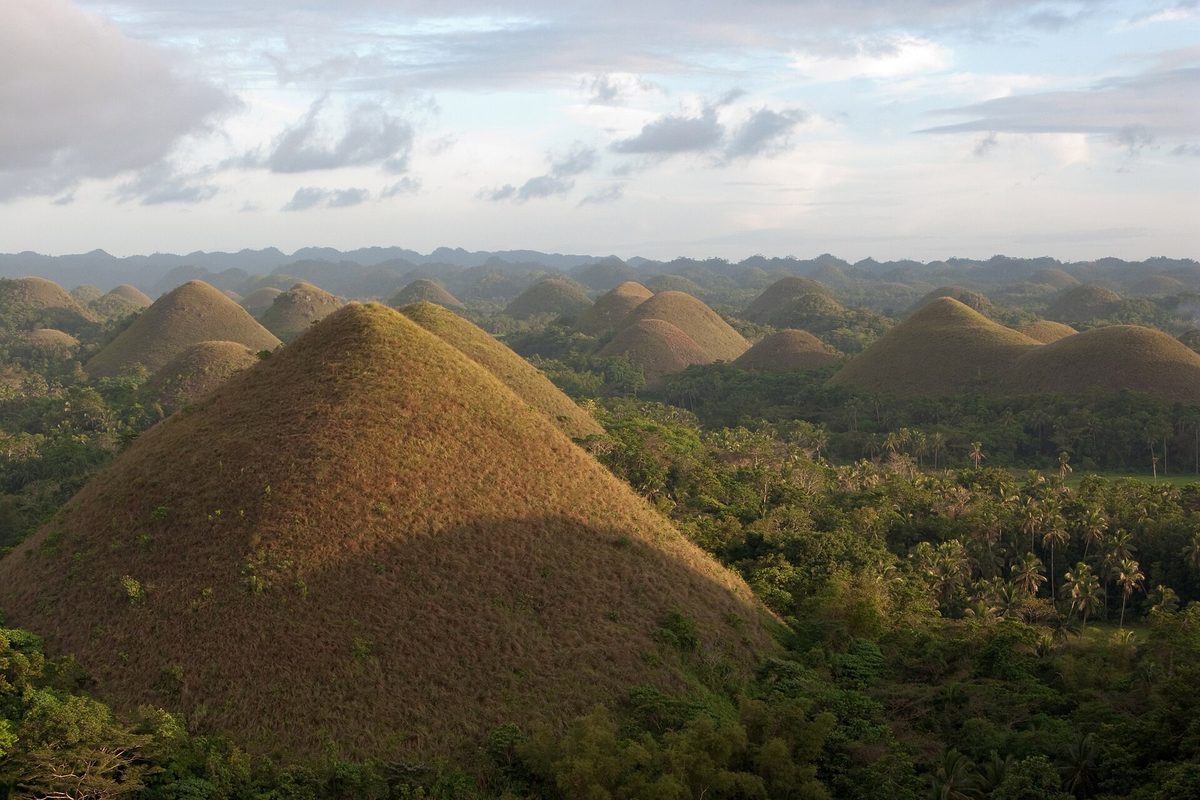
- Chocolate Hills — over 1,200 near-symmetrical grass-covered mounds that turn cocoa-brown in the dry season. The main Carmen viewing deck charges around ₱150 entry (it rose in late 2025, so verify the current rate). Climb the steps for the famous panorama; it is the photo you came to Bohol for.
- Tarsier sanctuary — visit the Philippine Tarsier Sanctuary in Corella (run by the Philippine Tarsier Foundation), not the roadside cages or the commercial exhibit nearer Loboc. Entry is about ₱150. These tiny, huge-eyed primates are intensely stress-sensitive, so the rules are strict: no flash, no touching, low voices. The Corella sanctuary actually enforces this, which is why it is the one I send people to.
- Loboc River — a floating-restaurant lunch cruise up a jade-green river fringed with jungle, usually with live acoustic music. It is touristy and I love it anyway; around ₱800–1,000 ($14–17) including the buffet.
- Man-Made Forest, Baclayon Church (one of the oldest stone churches in the country), and a butterfly garden usually round out the loop.


Day 6: island hopping, dolphins, and a beach day
Back to the water. From Alona Beach, a morning boat trip takes you out to Balicasag Island — a marine sanctuary with a wall dive and snorkel that is thick with turtles and reef fish — often paired with a dolphin-watching pass at dawn and a stop at the Virgin Island sandbar, a thread of white sand that surfaces at low tide. Expect ₱2,000–3,500 ($34–60) per boat for the half-day, plus small sanctuary fees, split among your group. Turtle sightings off Balicasag are close to guaranteed; I have never come up without seeing at least two.
Spend the afternoon doing as little as possible. Panglao’s quieter beaches — Dumaluan, Bingag, the cove at Momo — are a short tricycle ride from Alona and far emptier. They rank among the better beaches in the country, and you will likely have a stretch of sand to yourself.
Day 7: slow morning, fly home from Panglao
Last swim, last mango shake, and a 20-minute drive to Bohol-Panglao International (TAG) for your flight to Manila and onward. This is the payoff of the open-jaw plan: no ferry, no Cebu transfer, just a short ride to the gate. If you booked back through Cebu instead, take the first fast ferry of the morning from Tagbilaran and build in a generous buffer for city traffic to the airport.
The tighter 5-day Cebu Bohol itinerary
Only have five days? It still works beautifully — you just trim the slack, not the soul of the trip. Here is the compressed version I give friends on a long weekend:
- Day 1: Land at Mactan-Cebu, half-day in the historic centre, lechon dinner at Sugbo Mercado, sleep in the city.
- Day 2: Early bus south to Moalboal; afternoon free sardine run and turtles off Panagsama; overnight Moalboal.
- Day 3: Kawasan Falls canyoneering in the morning, then van back to Cebu and the afternoon fast ferry to Tagbilaran; overnight Panglao.
- Day 4: Full Bohol countryside loop — Chocolate Hills, Corella tarsiers, Loboc River lunch cruise; overnight Panglao.
- Day 5: Quick Alona Beach or Balicasag morning, then fly out of Bohol-Panglao (TAG).
The only real sacrifices in the five-day version are the dedicated island-hopping day and the slow Panglao beach afternoon. Skip Oslob entirely (you would not have time anyway) and you lose nothing you will miss.
Which version suits which traveller
A quick steer by traveller type, because the same route flexes a lot:
- First-timers and couples: the seven-day flagship as written. It is the cleanest possible introduction to the Visayas — adventure, wildlife, and beach, no backtracking, and it upgrades neatly into a Philippines honeymoon if you swap the Panglao nights for somewhere with a plunge pool.
- Families: keep the seven days but drop the highest canyoneering jumps (guides will route kids around them), skip Oslob without debate, and lean into the Loboc cruise and Balicasag turtles, which children adore. Panglao’s calm, shallow beaches are far more kid-friendly than Moalboal’s rocky shore.
- Divers: add two or three nights. Moalboal (Pescador, the sardine wall) and Panglao (Balicasag, Cabilao) are world-class, and you can easily fill a week underwater alone.
- Budget backpackers: the five-day version, all buses and shared vans, hostel dorms, and the free sardine run as your marquee experience. You can run this for well under $60 a day.
- Want a third island? If you have ten-plus days, extend south from Cebu to Dumaguete and Apo Island, or hop to Siquijor — both slot naturally onto the end of this route.
Frequently asked questions
How many days do you need for Cebu and Bohol?
Five days is the realistic minimum to do both islands without it feeling like a transit dash, and seven is the sweet spot. Five days gets you the Cebu adventure highlights, the ferry crossing, and a Bohol countryside loop. Seven adds a dedicated island-hopping day and unhurried beach time on Panglao. Fewer than five and I would honestly pick just one island.
Is it better to fly into Cebu or Bohol first?
Fly into Cebu (Mactan-Cebu, CEB) and out of Bohol-Panglao (TAG). Cebu has far more international and domestic connections, so it is the cheaper, easier arrival point, and the open-jaw exit from Panglao saves you a two-hour return ferry plus a city transfer on your last day. Only route back through Cebu if your onward flight forces it.
How do you get from Cebu to Bohol?
Take a fast ferry from Cebu Pier 1 to Tagbilaran. OceanJet and SuperCat run the route together roughly every 30–45 minutes from early morning to evening, and the crossing takes about two hours. Fares in 2026 run around ₱800–1,560 ($14–27) depending on operator and class. Book a day ahead on weekends and arrive at the pier an hour early.
Should I do the Oslob whale shark tour?
I recommend against it. The whale sharks at Oslob are fed daily to keep them in place for tourists, a practice that marine scientists and conservation groups including Green Fins consider harmful and unsustainable. You can have a wild, free, un-baited alternative on the same trip: the year-round Moalboal sardine run off Panagsama Beach. Read up first and decide with open eyes.
What is the best time of year to visit Cebu and Bohol?
The dry season from roughly December to May is the safest bet, with February to April the driest and the Chocolate Hills at their cocoa-brown best. The Visayas sit slightly outside the worst of the typhoon belt, but storms can still pass June to October, mostly as short heavy downpours. The sardine run, tarsiers, and ferries operate year-round.
Is Cebu and Bohol enough for a first Philippines trip?
For a one-week first trip, yes — it is arguably the single best introduction to the country, balancing adventure, rare wildlife, history, and beaches with short, easy transfers. If you have two weeks or more, treat this loop as the central block and bolt a Palawan or Siargao leg onto either end.
Sources and photo credits
Photo credits
Chocolate Hills, Bohol — Vyacheslav Argenberg (CC BY 4.0) via Wikimedia Commons
Magellan’s Cross, Cebu City — Ralff Nestor Nacor (CC BY-SA 4.0) via Wikimedia Commons
Moalboal sardine run, Cebu — Iampjanz (CC BY-SA 4.0) via Wikimedia Commons
Kawasan Falls, Badian, Cebu — Magalhães (Public domain) via Wikimedia Commons
Alona Beach, Panglao, Bohol — yeowatzup (CC BY 2.0) via Wikimedia Commons
Philippine tarsier, Bohol — John Martin PERRY (CC BY-SA 4.0) via Wikimedia Commons
Loboc River, Bohol — Kris Fulgencio (CC BY-SA 4.0) via Wikimedia Commons
Sources and further reading
Schedules, fares, and fees change often; we verified the following directly while researching this guide:
OceanJet ferry schedules and fares ·
SuperCat (Cebu–Tagbilaran) routes ·
Green Fins / Reef-World on responsible marine tourism ·
Philippine Department of Tourism.
About this guide: this is part of PhilippinesTourism.org, an independent, traveller-written resource. Routes, transfers, and prices reflect on-the-ground experience and were verified July 2026. Ferry times, tour fees, and flight schedules change — confirm the current details with operators before you travel.