
Do They Speak English in the Philippines? Language and Etiquette
Short answer: yes. English is one of the two official languages of the Philippines (alongside Filipino), the main medium of instruction in schools, and the working language of business, government, signage and tourism. It is among the largest English-speaking nations on earth, so you can plan an entire trip in English and never hit a wall.
To put a number on it: in the 2025 EF English Proficiency Index the Philippines placed 2nd in Asia and 28th of 123 countries worldwide, in the “high proficiency” band. In practice that means you can ask for directions, read every menu and check into every hotel in English from the moment you land.
I’ve travelled and worked across the country for years — from Makati boardrooms to a sari-sari store on a Siargao back road — and the honest, slightly more useful version of that answer is below: where English is strongest, where it thins out, why Tagalog is not the language everywhere, and the small handful of phrases and manners that turn a smooth trip into a warm one. If you’re still mapping the bigger picture, start with our Philippines itinerary guide and treat this as the language-and-manners companion to it.
English in the Philippines at a glance
Here’s the lay of the land before we get into detail — how reliable English is in the situations you’ll actually be in:
| Situation | How much English? | What to expect |
|---|---|---|
| Airports, hotels, resorts, dive shops | Excellent | Fluent, fast, used to foreigners. Zero friction. |
| Cities (Manila, Cebu, Davao, Iloilo) | Excellent | Shop staff, drivers, guards, baristas — nearly all comfortable in English. |
| Restaurants, malls, pharmacies, banks | Excellent | Menus, labels, ATMs and forms are in English by default. |
| Tricycle & jeepney drivers, market vendors | Good | Enough to agree a price and a destination; mix in gestures and place names. |
| Remote islands, mountain barangays, older farmers | Variable | Often basic but workable; a few local words and patience go a long way. |
| Official signs, transport, government offices | Excellent | Signage is overwhelmingly English (or English + Filipino). |
The pattern is simple: English gets stronger the closer you are to a city, a school, a screen or a tourist. It gets gentler in remote rural pockets and with some older folks who grew up speaking only their regional language at home. Either way, you are rarely on your own — Filipinos are famously willing to help, and someone nearby almost always speaks confident English.
Why is English so widely spoken here?
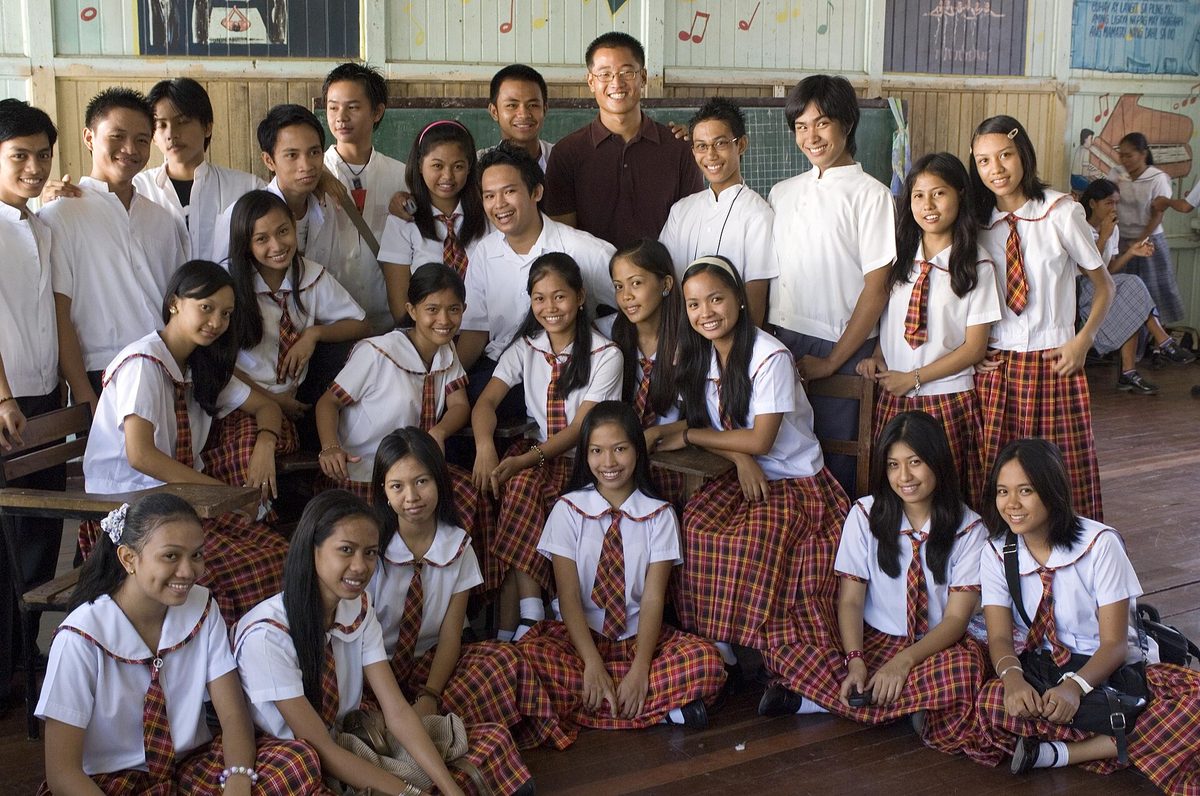
This isn’t a tourist-bubble illusion; it’s baked into the country’s history and law. The United States administered the Philippines from 1898 to 1946, and in 1901 a boatload of American teachers — the “Thomasites,” named after the ship USAT Thomas — fanned out across the islands to set up a public-school system that taught in English. That decision echoes a century later.
Today the legal backbone is the 1987 Constitution. Article XIV names Filipino as the national language and makes Filipino and English the official languages for communication and instruction. In practice that means children grow up bilingual: subjects like maths, science and (often) history are taught in English, while Filipino and the local regional language fill in the rest. Layer on a media diet of Hollywood films, American music and a huge business-process-outsourcing industry that runs in English, and you get a population that doesn’t just study English — it lives a chunk of daily life in it. Most Filipinos are comfortably at least bilingual, and many are trilingual (regional language + Filipino + English).

The language landscape: Filipino, Tagalog, and the regional languages you’ll actually meet
Here’s the thing most guides skate over. The Philippines has roughly 180 living languages — not dialects, genuinely distinct languages — and the one a local speaks at home depends entirely on where you are. “Filipino” (the national language) is essentially standardised Tagalog, the mother tongue of Manila and the surrounding southern Luzon provinces. It’s taught nationwide and most Filipinos understand it, but it is absolutely not everyone’s first language.
The single most useful thing I can tell a first-timer: Tagalog is not spoken everywhere. Fly to Cebu, Bohol or Siargao and the language on the street is Bisaya (Cebuano), not Tagalog. Locals there will happily speak Tagalog or English with you, but among themselves it’s Bisaya — and a tourist who busts out salamat (Tagalog) in Cebu, then learns salamat also works in Bisaya, scores double points. Greet someone in the wrong regional language and they’ll smile and switch; greet them in the right one and you’ve made a friend.
These are the big regional languages worth knowing by name, and where you’ll run into them:
| Language | Where you’ll hear it | Native speakers (approx.) |
|---|---|---|
| Tagalog / Filipino | Manila & southern Luzon; understood nationwide | ~26 million first-language |
| Cebuano (Bisaya) | Cebu, Bohol, Siargao, much of the Visayas & Mindanao | ~21 million |
| Ilocano | Northern Luzon (Ilocos, Cagayan, the Cordillera gateway) | ~8 million |
| Hiligaynon (Ilonggo) | Iloilo, Bacolod, Western Visayas (gentle, sing-song) | ~7 million |
| Waray | Eastern Visayas (Tacloban, Samar, Leyte) | ~3 million |
| Bikol | Bicol region, southeastern Luzon (near Mayon, Caramoan) | ~3 million |
| Kapampangan | Pampanga, north of Manila (famous food country) | ~2 million |
You do not need to learn any of these to travel well — English will carry you everywhere on this list. But knowing that Bisaya rules the central islands explains a lot: why your Tagalog app phrases get a puzzled look in Cebu, why a Boholano counts usa, duha, tulo instead of isa, dalawa, tatlo, and why the friendly correction you’ll get is a feature of the trip, not a problem. Want the regional picture mapped out properly? Our breakdown of the Philippine regions pairs perfectly with this section.
“Taglish” and how Filipinos actually talk
Listen to two friends in a Manila coffee shop and you’ll hear sentences that start in Tagalog, pivot to English mid-thought, and land back in Tagalog — all in one breath. That’s Taglish, and it’s not broken language or showing off. It’s the natural register of bilingual people, used everywhere from text messages to TV hosts to corporate meetings. In the Visayas you’ll hear the Bisaya equivalent (sometimes called “Bislish”).
For you as a traveller this is great news: the English half of Taglish means even when locals are chatting among themselves, you’ll catch numbers, place names, brand names and key verbs. Prices are almost always said in English (“one-fifty”), directions often are too. You’re rarely fully lost. And if you mangle a Tagalog word, no one minds — switching languages mid-sentence is the national pastime.

Useful Filipino phrases for tourists (with the Bisaya version too)
You can get by on pure English, but a handful of local words is the cheapest goodwill you’ll ever buy. Filipinos light up when a foreigner tries — it’s genuinely rare, and it reads as respect. Below are the phrases I actually use, with Tagalog first and the Bisaya (Cebuano) version where it differs, so you’re covered in both Manila and Cebu/Bohol/Siargao. Add po to almost anything when speaking to someone older and you instantly sound polite (more on that next).
| English | Tagalog | Bisaya / Cebuano |
|---|---|---|
| Thank you (polite) | Salamat (po) | Salamat |
| Yes / No | Oo / Hindi | Oo / Dili |
| Hello / How are you? | Kumusta? | Kumusta? |
| Good morning | Magandang umaga | Maayong buntag |
| Excuse me / sorry | Pasensya na (po) | Pasaylo |
| How much? | Magkano? | Tagpila? |
| Where is…? | Saan ang…? | Asa ang…? |
| Water | Tubig | Tubig |
| Left / Right | Kaliwa / Kanan | Wala / Tuo |
| Stop (to a driver) | Para! | Para! |
| Delicious | Masarap | Lami |
| Beautiful | Maganda | Nindot |
| I don’t understand | Hindi ko maintindihan | Wala ko kasabot |
Two crowd-pleasers worth memorising: salamat po (thank you, respectfully) and para! — the magic word that makes a jeepney or tricycle stop for you. Notice tubig (water) and para are the same in both languages, while “how much” flips from magkano to tagpila the moment you land in Cebu. That one swap alone will save you blank stares in the Visayas.
How to make sure you’re understood
English here is excellent, but it’s Philippine English — closer to American than British, with its own rhythm and vocabulary. A few habits help enormously:
- Speak clearly and a touch slower, and skip heavy slang or idioms. “It’s raining cats and dogs” or “can you ballpark it” will get a polite nod and zero comprehension. Plain words win.
- Learn the local vocabulary, because some everyday words differ. A bathroom is the CR (comfort room), not the toilet or restroom. Takeaway food is “take out” and dining in is “for here” (or “dine in”). A water heater is an “heater,” a fridge is a “ref,” and a small neighbourhood shop is a sari-sari store.
- Watch for “yes” that means “I hear you,” not “I agree.” To avoid seeming rude, some people won’t flatly say no. If an answer feels vague, ask an open question (“what time does the last ferry leave?”) rather than a yes/no one.
- Mind British vs American terms. Ask for the “bill” and you may get a blank look; “check, please” lands cleanly. “Chips” means crisps; fries are “fries.”
None of this is a real barrier. It’s just the difference between being understood on the first try and the second. Speak plainly, point at the menu, say the place name, and you’ll glide.
Philippines etiquette for tourists: the manners that actually matter
Filipino culture is warm, family-centred and gently formal in ways that reward a little awareness. None of this is a minefield — locals forgive foreigners almost anything — but lean into these and you’ll feel the temperature of every interaction rise.
“Po” and “opo”: the respect markers
The single highest-value word in the country is po. You sprinkle it into sentences when addressing anyone older or in authority, and it softens everything into politeness: salamat po (thank you), oo po / opo (a respectful yes), pasensya po (sorry). You don’t need to parse the grammar — just tack po onto your thank-yous and yeses and you’ll come across as someone who gets it. It costs nothing and earns a lot.
Mano po: blessing an elder’s hand
The mano is a beautiful gesture you’ll see at every family gathering: a younger person takes an elder’s hand and gently presses the back of it to their own forehead, often saying “mano po,” to ask for a blessing. As a visitor you won’t be expected to do it, but if you’re welcomed into a Filipino home and meet a grandparent (a lola or lolo), offering the mano is a quietly moving way to show respect. They’ll be delighted.
The lips don’t lie: pointing and gestures
Ask where the CR is and you may get directions delivered with pursed lips rather than a finger — a little pout aimed at the doorway. It’s completely normal and weirdly efficient once you tune into it. Pointing at people with your index finger is considered rude; Filipinos gesture with an open hand, a nod of the head, or those expressive lips instead. Beckoning is done palm-down, fingers waving toward yourself.
You will be fed (hospitality)
Hospitality here is not a figure of speech. Visit anyone’s home and you will be offered food, and refusing outright can read as cold — at least accept a little, even if you’re full. If you’re invited somewhere, bringing pasalubong (a small gift — pastries, fruit, snacks from where you’ve been) is the perfect gesture; keep it modest, as something lavish can cause embarrassment. When a Filipino says “just join us,” at a meal, they mean it. This generosity is one of the things I love most about travelling here, and it’s on full display around the table — our guide to Filipino food is the best way to know what you’re being so warmly handed.
At the table and out and about
A few practical manners that come up daily:
- It’s the “comfort room,” not the toilet. Signs say CR. Ask “where’s the CR?” and everyone understands instantly; ask for the “bathroom” and they may point you to a room with an actual bath.
- “For here or take out?” is how you’ll be asked at counters. Spoons and forks rule — the fork pushes food onto the spoon, which does the eating; knives are often absent. Eating kamayan (with clean hands, off banana leaves) is a joy if you get the chance.
- Remove your shoes when entering most Filipino homes (and some guesthouses). Follow your host’s lead; if you see a pile of slippers at the door, yours join them.
- Tipping is appreciated, not mandatory. Many restaurants add a 10% service charge — check the bill before adding more. Where there’s none, rounding up or leaving around 10% is generous and kind. For hotel porters, ₱50–100 (about $1–2) is plenty; for tricycle and taxi drivers, rounding up is fine.
Religion: dress modestly and respect the calendar
The Philippines is predominantly Roman Catholic (with a significant Muslim population in parts of Mindanao), and faith is woven into daily life. Churches are everywhere and worth visiting — just dress modestly inside: covered shoulders and knees, hats off. A light long-sleeve layer or a scarf handles it, which is why one lives on our Philippines packing list. During Holy Week (the days leading to Easter), the country genuinely slows down: many businesses, ferries and domestic flights reduce service on Maundy Thursday and Good Friday, and some islands go quiet. It’s a fascinating time to visit, but plan transport ahead. In Muslim areas, dress a touch more conservatively and be mindful around prayer times and Ramadan.
Karaoke is sacred (and a few quirks)
Filipinos love karaoke — it’s a national bonding ritual, and being invited to sing is a sign you’re welcome. Take the mic, pick something cheerful, and don’t worry about being good. Two friendly warnings: people take it seriously enough that mocking someone’s singing is a real faux pas, and the country has a long-standing superstition about the song “My Way,” so maybe pick a different ballad. Beyond that, expect a culture that smiles to keep things harmonious, avoids public confrontation, and treats a raised voice as a loss of face — stay easygoing and you’ll fit right in.
“Filipino time”
Socially, things run on “Filipino time” — a relaxed relationship with the clock where a casual meet-up at 7 might genuinely mean 7:30. Don’t take it personally; it’s cultural, not rude. The flip side: anything involving transport — ferries, buses, domestic flights — runs on real time, and you should be early. For the moving-around logistics, our guide to getting around the islands saves a lot of guesswork.

A few honest, opinionated calls
After enough trips, here’s where I’ll stick my neck out:
- Don’t over-prepare the language. Some travellers fret about learning Tagalog before a Cebu trip — where it’s the wrong language anyway. Learn five courtesy words, lead with English, and spend your energy elsewhere.
- Do learn po, salamat and para. These three punch far above their weight. Po earns respect, salamat earns smiles, para earns a stopped jeepney exactly where you want it.
- Worth every peso: a local SIM or eSIM. Not language as such, but data lets you show a map, translate a menu word, and message a guesthouse — it removes 90% of the rare friction.
- Skip the worry. The fear that you won’t be understood is the most overblown concern first-timers carry. You will be. The bigger adjustment is the warmth — people will chat, ask where you’re from, and feed you. Lean in.
If safety is also on your mind (it’s the other big first-timer question), our honest take on whether the Philippines is safe pairs well with this one. And once you’ve got the language and manners sorted, the fun part — the things to do across the islands — is where this all pays off.
Where English is strongest — and where it thins out
It helps to picture English proficiency as a gradient rather than a yes/no. Here’s how it actually breaks down on the ground:
Rock-solid English: anywhere tourism, business or schooling concentrates. Manila and Cebu, resort islands like Boracay, Palawan and Siargao, dive towns, malls, airports, hospitals, banks and call-centre districts. Here English isn’t just understood — it’s often the working language, and you’ll forget you’re in a non-native-speaking country. Younger Filipinos in particular are fluent, fast and fond of pop-culture references you’ll recognise.
Good, workable English: provincial towns, public markets, jeepney and tricycle drivers, smaller eateries. People may pause to find a word, or answer in Taglish, but you’ll always land your meaning — especially with a place name and a smile. This is the bulk of everyday travel, and it’s frictionless.
Patchier English: far-flung islands, mountain barangays, and some older folks who spent their lives speaking only Ilocano, Waray or Bisaya at home. Even here it’s rarely zero — there’s almost always a younger relative, a shopkeeper or a passer-by who’ll happily translate. A few local words and a patient, friendly manner cover the rest.
By traveller type
- First-timers & families: you’ll be completely fine. Stick to cities and tourist hubs and English is effectively universal. The Philippines is one of the easiest countries in Asia to navigate language-wise — arguably the easiest.
- Solo & budget travellers: you’ll wander into more Taglish and more regional language, which is half the fun. Pick up the local courtesy words wherever you are; they open doors (and free snacks).
- Long-stay & digital nomads: you can live entirely in English, but learning your area’s language — Bisaya in Cebu, Tagalog in Manila — transforms how locals treat you, from tourist to neighbour.

Frequently asked questions
Do they speak English in the Philippines?
Yes — widely and well. English is one of two official languages, the medium of instruction in schools, and the default for business, government, signage and tourism. The country ranks among the top English-speaking nations and placed 2nd in Asia in the 2025 EF English Proficiency Index. You can travel the entire country in English; it’s simply strongest in cities, tourism and among younger people, and a little thinner in remote rural areas.
Do I need to learn Tagalog to visit the Philippines?
No. English alone will carry you through hotels, restaurants, transport and attractions everywhere. A few courtesy words (salamat, po, para) earn real goodwill, but they’re a bonus, not a requirement. And remember Tagalog isn’t universal — in Cebu, Bohol and Siargao the local language is Bisaya, so don’t over-invest in Tagalog for a Visayas trip — the standard two-week Philippines itinerary spends its first half in Bisaya country.
What language is spoken in Cebu and Bohol?
Bisaya (Cebuano) is the everyday language across Cebu, Bohol, Siargao and much of the Visayas and Mindanao — not Tagalog. Locals also speak fluent English with visitors and understand Tagalog, but among themselves it’s Bisaya. Learning even one Bisaya word (try lami for “delicious”) goes down a treat there.
Is it easy to get around the Philippines speaking only English?
Very. Signs, menus, tickets, ATMs and apps are in English; drivers, guards and shop staff are used to English-speaking visitors. Speak clearly, skip heavy slang, and learn a couple of local terms (the bathroom is the “CR,” takeaway is “take out”) and you’ll rarely hit a snag.
What percentage of Filipinos speak English?
Estimates vary by how you count, but well over half of adults speak conversational English, and a far larger share can read and understand it — figures of 60% and up are commonly cited. Comprehension is even higher than spoken fluency, thanks to English-language schooling, signage and media. In tourist areas the practical figure feels close to universal.
What should I avoid doing in the Philippines?
Don’t point at people with your finger, raise your voice in disputes, or flatly refuse food in someone’s home — all read as rude. Dress modestly in churches, don’t mock anyone’s karaoke, and use po with elders. None of these are strict rules; they’re the small courtesies that make Filipinos warm to you fast.
Sources and photo credits
Photo credits
Metro Manila skyline (Makati, BGC, Ortigas) — Patrick Roque (CC BY-SA 4.0) via Wikimedia Commons.
A neighbourhood sari-sari store — User:Exec8 (Public domain) via Wikimedia Commons.
A jeepney on a Manila street — Bahnfrend (CC BY-SA 4.0) via Wikimedia Commons.
A Philippine classroom — Peace Corps (Public domain) via Wikimedia Commons.
Manila Cathedral, Intramuros — Patrick Roque (CC BY-SA 3.0) via Wikimedia Commons.
A Philippine public market — Judgefloro (CC0) via Wikimedia Commons.
Sources and further reading
For the facts behind this guide: the 1987 Constitution, Article XIV (official languages); the EF English Proficiency Index – Philippines (2025 ranking); the Philippine Department of Education (medium of instruction); and the official Philippine Department of Tourism for destination guidance.
About this guide: this is part of PhilippinesTourism.org, an independent, traveller-written resource. We research on the ground and cross-check perishable facts against official sources; details such as service levels and prices can change, so confirm anything time-sensitive locally. Verified July 2026.