Philippine Festivals: A Traveler’s Calendar & Survival Guide
The first time you get pulled into a Filipino fiesta, you stop being a tourist and become a participant whether you agreed to it or not. Someone smears soot on your cheek, hands you a drink, and the drumline decides your feet. The best Philippines festivals are Sinulog in Cebu, Ati-Atihan in Kalibo, Dinagyang in Iloilo, Panagbenga in Baguio, MassKara in Bacolod and Kadayawan in Davao, and this guide tells you when each happens, what to expect, and how to survive one without losing your wallet or your mind.
That is the short version. The long version is what follows: a recurring-date calendar you can actually plan a trip around, honest notes on each of the big ones, and a survival section nobody else seems willing to write. I have spent a fair amount of January in Cebu and a fair amount of October in Bacolod, and I will be straight with you about the heat, the crowds, the room prices and the question every first-timer asks, which is whether to dance or just watch. (Dance. Always dance.)
A quick word on dates before we go further. Filipino festivals recur every year, but most of the big ones float, tied to a particular Sunday or to Holy Week rather than a fixed calendar date. I have framed everything below as a recurring pattern (“third Sunday of January”) rather than pinning a single year, because that is how they actually work. Always confirm the exact dates and the parade schedule with official city sources before you book flights, because routes and judging days do shift. If you want help slotting a festival into a wider trip, our guide to the best time to visit the Philippines pairs neatly with this one, and the whole thing sits under our larger roundup of things to do in the Philippines.
Philippines Festivals Calendar: Month by Month at a Glance
Here is the entire festival year on one screen. Prices to attend the street events are essentially free; the cost is in flights and a bed, both of which spike hard around the marquee names. “Book-ahead level” is my honest read on how early you need to lock a room, from relaxed to genuinely months out.
| Festival | City / Province | When (recurring) | What it is about | Book-ahead level |
|---|---|---|---|---|
| Ati-Atihan | Kalibo, Aklan | Second to third week of January (climax third Sunday) | The soot-painted, participatory “mother of Philippine festivals,” honoring the Santo Nino | High — months ahead |
| Sinulog | Cebu City | Third Sunday of January | The country’s biggest single-day party; a devotional dance to the Santo Nino | Very high — the city sells out |
| Dinagyang | Iloilo City | Fourth Sunday of January | The most choreographed of the lot; “Ati warrior” tribes compete in tight formations | High — hotels fully book |
| Panagbenga (Flower Festival) | Baguio | Whole of February into early March | Flower floats and street dancing in the cool mountain capital | High on float-parade weekend |
| Moriones | Marinduque | Holy Week (March or April) | Masked “Roman soldiers” roam towns in a centuries-old Lenten street drama | High — Holy Week travel peak |
| Pahiyas | Lucban, Quezon | May 15 (fixed) | Houses dressed in colorful rice-wafer kiping, fruit and harvest, honoring San Isidro | Moderate to high |
| Kadayawan | Davao City | Third week of August | A harvest thanksgiving celebrating fruit, flowers and 11 indigenous tribes | Moderate |
| MassKara | Bacolod | Around the fourth Sunday of October | Grinning masks, electro-Latin beats and the self-styled City of Smiles | High — book early |
| Town patron-saint fiestas | Everywhere | Year-round | Every barangay has one: Mass, procession, lechon, videoke until dawn | Low — just turn up |
If you only remember one row, make it January. Three of the country’s heavyweight festivals land within two weeks of each other in the Visayas, which means a determined traveler can theoretically catch Ati-Atihan, Sinulog and Dinagyang in a single trip, one of the great entries on any Philippines bucket list. I will explain below why that is both glorious and slightly unhinged.
January in the Visayas: The Big Three
January is the high holy month of Filipino festival-going. The dry season is at its kindest, the schools are back, and three Santo Nino festivals fire off in succession across the central islands. They share a root and a saint, but they could not feel more different on the ground.
Sinulog Festival
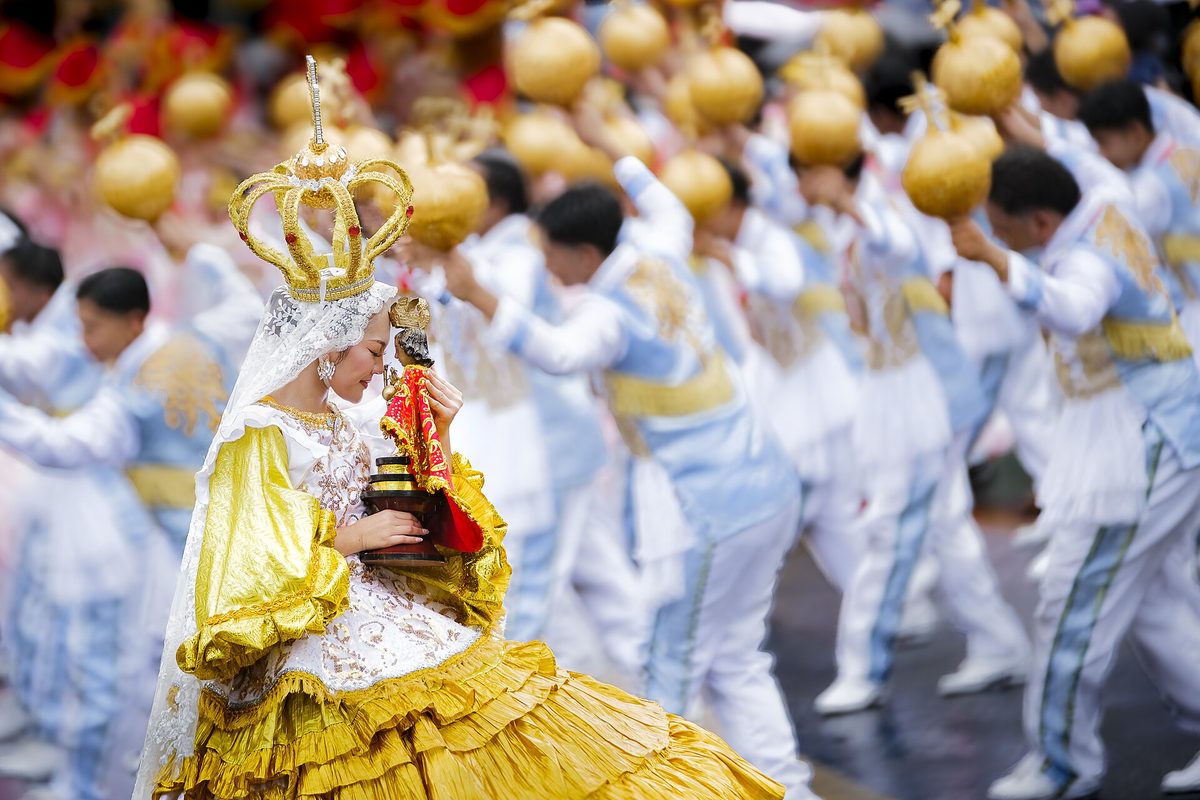
Sinulog is the giant. Held on the third Sunday of January in Cebu City, it is the largest single-day festival in the country, drawing crowds counted in the millions, and the energy is closer to a citywide rave with a religious heart than to a polite parade. The name comes from the Cebuano word sulog, the current of a river, which is exactly what the two-steps-forward, one-step-back Sinulog dance imitates. Underneath the spectacle is genuine devotion to the Santo Nino, the image of the Child Jesus that, by tradition, dates to Magellan’s arrival in 1521.
Here is the honest shape of the day. The grand parade runs for hours along a long downtown route, contingents in heavy costumes dancing the whole way in tropical heat, and finding a good vantage point means committing early. The street parties, meanwhile, start the night before and outlast the parade by a wide margin. My advice: pick your lane. If you want the cultural showcase, get a grandstand ticket and go in the morning. If you want the party, accept that you will see less of the dancing and more of the crowd, and that is a perfectly valid Sinulog too.
Practicalities are where most people get caught out. Cebu City genuinely sells out, hotels often quadruple their rates and many require multi-night minimums, so book months ahead or stay out toward Mactan and commute in early before the road closures bite. Pack a small crossbody bag worn in front, wear shoes you can lose, and carry water. Sinulog sits in the heart of the wider city break that our Cebu travel guide covers, so it slots neatly onto the front of a Cebu-and-Bohol trip — or a run down the south coast to swim with whale sharks — if you can stand the contrast between this and a quiet island the next morning.
Ati-Atihan Festival
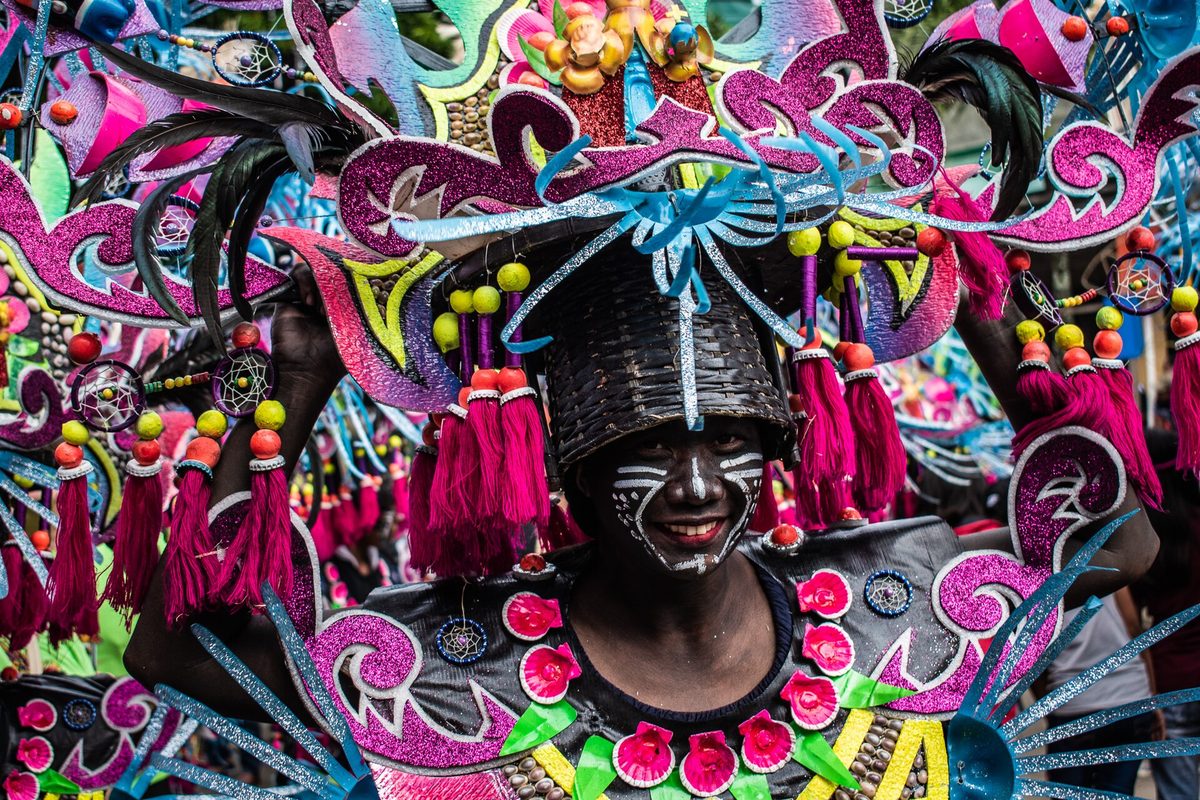
If Sinulog is the giant, Ati-Atihan is the ancestor. Held in Kalibo, Aklan across the second and third weeks of January and climaxing on the third Sunday, it is widely called the mother of Philippine festivals, and it earned the title: Sinulog and Dinagyang were both consciously modeled on it. What sets Ati-Atihan apart is that it is not a spectator event in any real sense. Revelers smear their faces and bodies with soot to honor the Ati people, the dark-skinned first inhabitants of Panay, and the streets become one enormous moving drum circle that absorbs anyone standing still for too long.
The chant is “Hala Bira!” and the correct response to being pulled into a tribe of strangers is to go with it. This is the festival I send people to when they tell me they want something raw and participatory rather than staged. There are no grandstands to hide behind; you are either dancing or you are in the way. The atmosphere is unusually warm and unselfconscious, helped by the fact that everyone looks slightly ridiculous in soot, which is a great social leveler.
Logistically, Kalibo has a small airport but limited rooms, so it fills fast and prices climb. Many travelers fly into Kalibo specifically because it is the mainland gateway to Boracay, which makes a tidy pairing: a few days of drum-circle chaos followed by a recovery stint on White Beach an hour or two away. If that is your plan, our Boracay travel guide sorts the second half of the trip. Bring clothes you do not mind ruining, because the soot is the whole point and it gets everywhere.
Dinagyang Festival
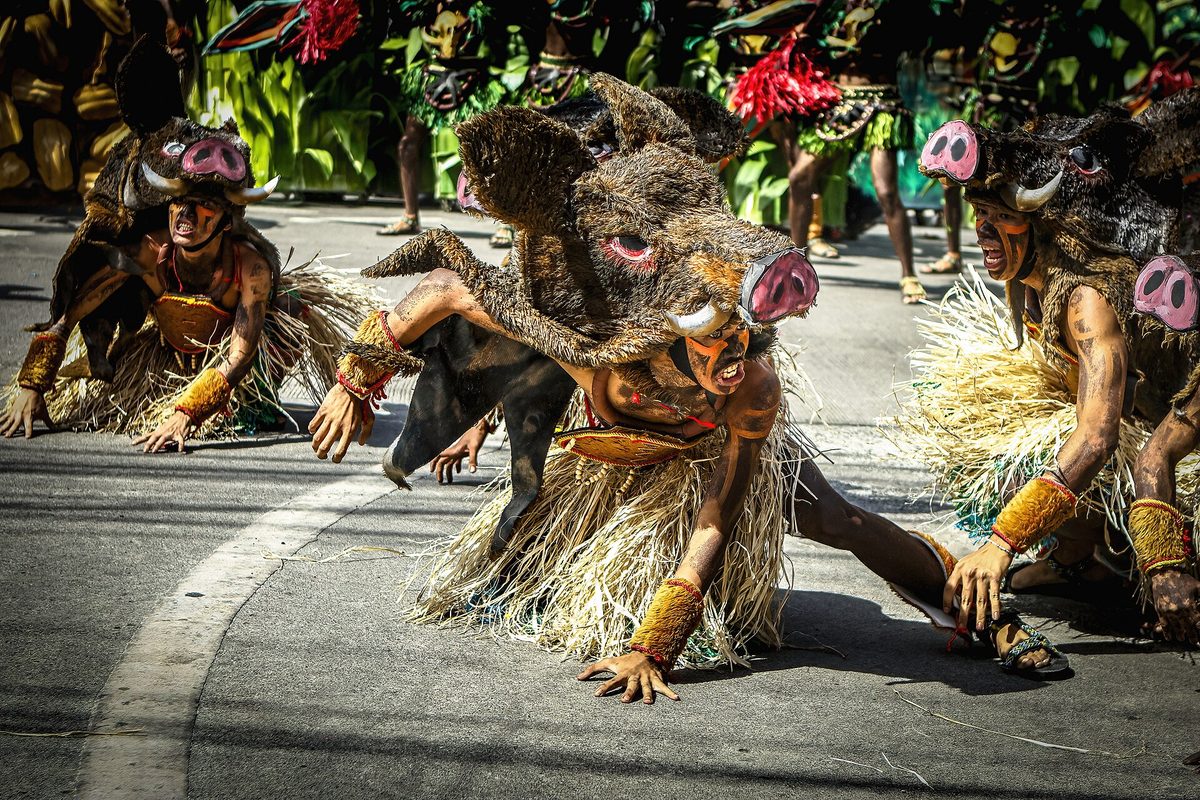
Dinagyang, on the fourth Sunday of January in Iloilo City, is the perfectionist of the three. Where Ati-Atihan is gloriously loose, Dinagyang is drilled to the second. Its centerpiece is the Ati Tribes Competition, in which “Ati warrior” tribes, mostly organized by local high schools, perform tightly choreographed routines in towering feathered headdresses, set to thunderous drums and PVC-pipe percussion the festival more or less invented. It is the most awarded festival in the country, and once you watch a championship-level tribe hit its formations in unison, you understand why.
For travelers who find the sheer scrum of Sinulog overwhelming, Dinagyang is a gentler entry point: it is huge, drawing well over a million people, but the main competition happens at judging areas and grandstands, so there is structure to grab onto. The catchphrase here is “Hala Bira, Iloilo!” and the food scene is a serious bonus, because Iloilo is one of the best eating cities in the Philippines. Hotels do fully book for the weekend, so reserve early; Iloilo’s compact, walkable downtown is part of the appeal once you are in.
One honest note worth knowing: the tribes paint their skin and wear Ati-inspired costumes, but the actual Ati community of Panay does not generally compete in or profit from the event, and in recent years organizers have invited Ati groups to perform non-competitively in acknowledgment of that. It does not spoil the spectacle, but it is the kind of context that makes you a more thoughtful guest.
February to May: Flowers, Holy Week and Edible Houses
After the January blitz, the festival calendar spreads out and gets more varied. This stretch gives you a flower festival in the mountains, a solemn-and-strange Lenten tradition, and the single most photogenic harvest celebration in the country.
Panagbenga Festival
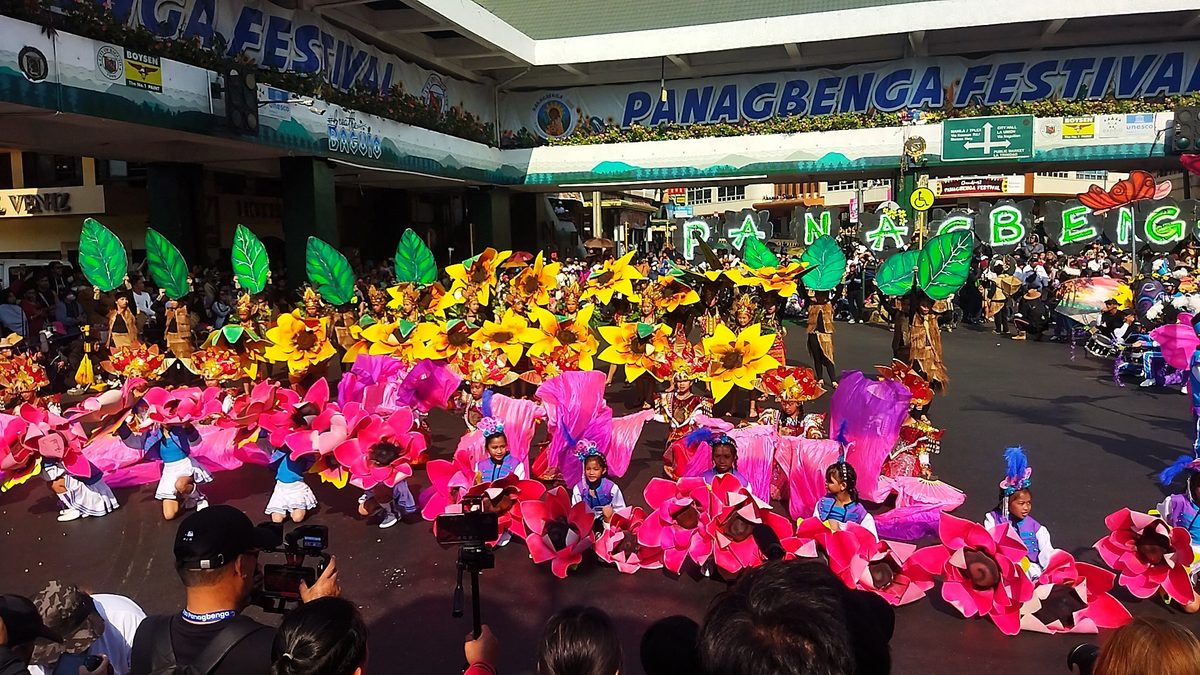
Panagbenga, the Baguio Flower Festival, takes over the cool mountain capital for the whole of February and spills into early March. The name means “season of blooming” in the local Kankanaey language, and the festival was born in the 1990s partly to lift the city’s spirits after a devastating earthquake. The two set-piece weekends near the end of the month are the draw: a grand street-dancing parade and, the next day, a float parade where enormous floats are clad entirely in fresh flowers and roll down Session Road.
What makes Panagbenga a pleasure is the weather. Baguio sits at altitude, so while the rest of the country swelters, you are in pine-scented air that can actually feel cold at dawn, sipping strawberry taho and watching marching bands. It is the most family-friendly of the big festivals and the least physically punishing. The catch is that half the lowlands have the same idea: Baguio’s roads choke and rooms vanish on the parade weekends, so either book a long way out or visit midweek earlier in the month, when the city is still in flower-festival mode without the crush. Baguio is the headline act of our Northern Luzon travel guide, which is worth a read if you want to extend the trip up to Sagada and the rice terraces.
Moriones, Holy Week and the patron-saint fiesta machine
Holy Week, the week before Easter (it floats between late March and April), is when Catholic devotion goes very public. The standout for travelers is the Moriones Festival on the island province of Marinduque, where men dress as moriones, the Roman soldiers of the Passion story, in carved wooden masks and helmeted costumes, and roam the towns for the week in a folk drama centered on the legend of Longinus. It is part street theater, part penance, and visually unlike anything else on this list. Be aware that Holy Week is also one of the two times a year the entire country travels at once, so transport and accommodation sell out and prices climb everywhere, not just in Marinduque.
Holy Week aside, this is the right moment to mention the festival you cannot put on a calendar: the town fiesta. Every single town and barangay in the Philippines has an annual fiesta for its patron saint, which means that on almost any week of the year, somewhere near you, there is a Mass, a procession, a basketball tournament, a beauty pageant and a street lined with tables where strangers will wave you over to eat. These are the soul of Filipino festival culture, and they are free, unticketed and genuinely welcoming. If you are based in the capital around a local feast day, our Manila travel guide can point you toward neighborhood celebrations. Ask a local when the town fiesta is; the answer is often “soon.”
Pahiyas Festival
Pahiyas, held on the fixed date of May 15 in Lucban, Quezon, is the harvest festival that turns an entire town into an art installation. Households compete to decorate their facades with produce, rice, woven palm and, above all, kiping: leaf-shaped wafers of colored rice paste that hang in glittering clusters and can be peeled off and grilled afterward. It honors San Isidro Labrador, the patron of farmers, as thanks for the harvest. Wandering Lucban’s streets gawking at the houses, eating pancit habhab off a banana leaf and Lucban longganisa hot off the grill, is one of the great low-key food-and-culture days in Luzon. It is a day trip more than a multi-day affair for most, but Lucban is small, so go early and expect crowds on the prettiest streets.
August to October: Mindanao Harvest and the City of Smiles
The second half of the year is quieter on the festival front until two big ones close it out: a Mindanao harvest thanksgiving in August and, in October, the most joyfully strange festival in the country.
Kadayawan Festival
Kadayawan takes over Davao City in the third week of August, a thanksgiving for the harvest and a celebration of the eleven indigenous tribes of the Davao region. The name comes from a friendly local greeting rooted in the word for “good” and “valuable,” and the festival leans into abundance: streets and stalls heaped with the region’s famous fruit, durian above all, alongside flowers, orchids and tribal craft. The signature events are the Indak-Indak street-dancing competition and the Pamulak floral float parade.
What I like about Kadayawan is that it foregrounds indigenous Mindanao culture rather than the Spanish-Catholic frame that shapes most of the festivals on this list, which makes it feel distinct. It is also the most relaxed of the major festivals to attend; Davao is a large, orderly city with plenty of rooms, so the book-ahead pressure is real but milder than in Cebu or Bacolod. Come hungry, and if you have never met a durian, this is the place to lose that particular innocence. Davao is the gateway to the wider south, with Mount Apo and the Philippine Eagle Center nearby for a culture-and-nature combination.
MassKara Festival
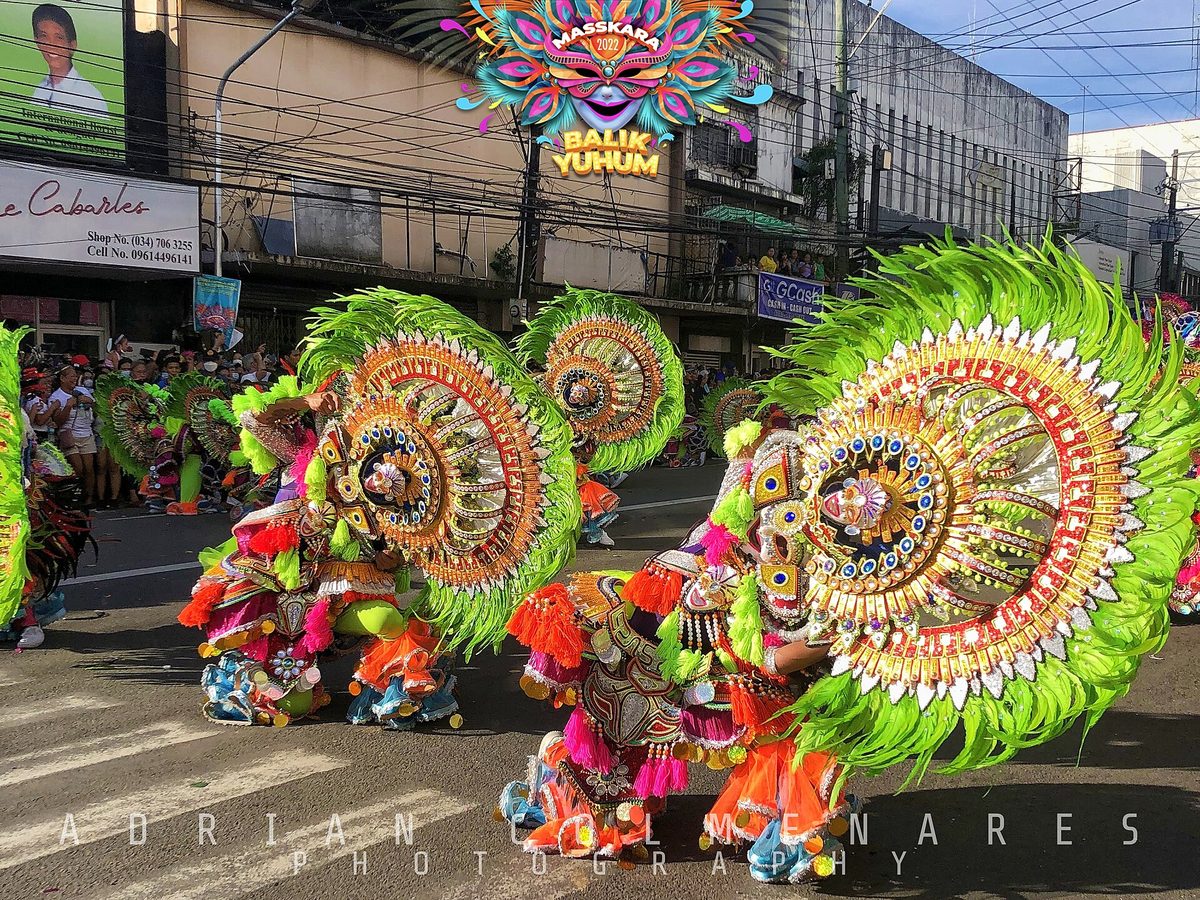
MassKara, in Bacolod around the fourth Sunday of October, is my sentimental favorite, and its backstory is the reason. The name is a pun: mass (a crowd) plus the Spanish cara (face), a play on maskara, the word for mask. It was born in 1980, a brutal year for Bacolod: the sugar industry that the city ran on had collapsed, and a ferry disaster had just killed scores of locals. The mayor and the city’s artists responded not with mourning but with defiance, staging a festival of smiling masks to live up to Bacolod’s nickname, the City of Smiles. That tension between the grief underneath and the grin on top is what gives MassKara its strange, moving power.
On the ground it is pure carnival. Dancers in glittering, fixed-smile masks move to a Latin-electronic beat that is closer to Rio than to a church procession, and the action centers on Lacson Street, a long strip that fills with band stages, food stalls and, in the evenings, the Electric MassKara: neon-and-LED costumes and illuminated floats parading up and down after dark. It is the festival I recommend to people who want a party without the sheer overwhelming scale of Sinulog. Bacolod is also one of the country’s great food cities, so build in time for chicken inasal, which the locals do better than anyone. Rooms book up well ahead for the highlight weekend, so reserve early, and pace yourself, because MassKara is a multi-day endurance event disguised as a street party.
How to Survive a Philippine Fiesta
The festivals are free and the welcome is real, but a marquee fiesta will still chew up an unprepared traveler. Here is everything I wish someone had told me before my first Sinulog.
Book accommodation months ahead, and brace for the prices
This is the single biggest mistake people make. For Sinulog, Dinagyang, MassKara, Ati-Atihan and Panagbenga’s parade weekend, host cities genuinely fill, and the rooms that remain often double, triple or quadruple in price, sometimes with multi-night minimums attached. I am not exaggerating; a basic room that runs PHP 1,800 (around $31) in an ordinary week can ask PHP 6,000 or more during Sinulog weekend. Book two to three months out for the big ones, or stay in a satellite town and commute in. The patron-saint town fiestas are the happy exception: those you can wander into with no booking at all.
Respect the heat, the crowd and the pickpockets
Three practical hazards, all manageable. The heat is relentless on parade days, so hydrate constantly, find shade between contingents, and do not underestimate how draining standing in a packed street for hours can be. The crowds at Sinulog and Dinagyang are vast, so agree a meeting point with your group because phone signal collapses under that many people. And where there are crowds, there are pickpockets: wear a small bag across your chest, keep your phone in a front pocket, leave the passport and most of your cash in the hotel safe, and bring just enough for the day. None of this is cause for paranoia, it is just the same street sense any big festival anywhere demands.
Joining versus watching, and what to wear
The eternal first-timer question. My answer is to join, every time the festival allows it. Ati-Atihan is built for participation; Sinulog and MassKara have street-party zones where outsiders are pulled in happily; Dinagyang’s main competition is more of a spectator event, but the sadsad street-dancing around it is open to all. The festivals reward people who say yes. As for clothing: light, breathable, quick-drying fabrics, closed shoes you do not love (they will get stepped on, soaked or sooted), a hat, sunscreen, and for Ati-Atihan specifically, clothes you are prepared to throw away afterward. Leave anything precious at home.
Eat the lechon, drink the local thing, tip the drummers
Every fiesta runs on food, and the centerpiece is almost always lechon, the whole roast pig with shattering crackling skin that is the national celebration dish. At a town fiesta you may simply be handed a plate; accept it, it is rude not to. Beyond lechon, eat the regional specialty wherever you are: inasal in Bacolod, fresh seafood and cakes in Iloilo, durian and pomelo in Davao, longganisa in Lucban. Carry small bills, because the best food comes from stalls that cannot break a large note. And if a roving drum tribe adopts you for an hour, a tip or a round of drinks for the crew is good manners and buys you a front-row spot in the chaos. The point of a Filipino fiesta is not to observe it from a safe distance. It is to be absorbed, fed, exhausted and sent home grinning.
Frequently Asked Questions
What is the most famous festival in the Philippines?
Sinulog in Cebu City is the most famous and the largest, drawing crowds in the millions on the third Sunday of January for a devotional dance to the Santo Nino. Ati-Atihan in Kalibo is older and more participatory, and is called the mother of Philippine festivals. For sheer scale and name recognition, though, Sinulog wins.
When is the best time to visit the Philippines for festivals?
January, without much contest. Three of the country’s heavyweight festivals (Ati-Atihan, Sinulog and Dinagyang) land within two weeks of each other in the Visayas, all during the pleasant dry season. February adds Panagbenga in Baguio, and October closes the year with MassKara. A determined traveler can build an entire trip around January alone.
What is the mother of all Philippine festivals?
Ati-Atihan in Kalibo, Aklan, celebrated in the second and third weeks of January. The National Commission for Culture and the Arts has called it the mother of Philippine festivals because the better-known Sinulog and Dinagyang were both consciously modeled on it. Revelers paint themselves with soot to honor the Ati people, and the whole event is built around participation rather than watching.
Do festivals in the Philippines cost money to attend?
The street events themselves are free; you can watch and join the parades, dancing and processions without paying. The real cost is travel and lodging, which spike sharply in host cities during the big festivals. Grandstand seats for the main competitions at Sinulog and Dinagyang are ticketed if you want a guaranteed view, but the street is open to everyone.
Are Philippine festivals safe for tourists?
Broadly yes. The major festivals are well-organized, heavily policed and welcoming, and millions attend without incident each year. Apply normal big-crowd sense: wear a bag across your chest, keep valuables in the hotel safe, agree a meeting point in case phone signal drops, and watch for pickpockets in the densest crush. The heat is a bigger practical risk than crime; hydrate and find shade.
Can I join the dancing or do I just watch?
Join, whenever the festival allows it, which is most of the time. Ati-Atihan is designed to pull you in, and Sinulog and MassKara have open street-party zones. Dinagyang’s flagship competition is more of a spectator event, but the street dancing around it welcomes anyone. Wear clothes you do not mind ruining, say yes, and the festival will do the rest.
Sources and photo credits
Photo Credits
- Sinulog Festival dancers, Cebu — via Wikimedia Commons
- Ati-Atihan Festival, Kalibo — via Wikimedia Commons
- Panagbenga Flower Festival, Baguio — via Wikimedia Commons
- MassKara Festival, Bacolod — via Wikimedia Commons
- Dinagyang Festival, Iloilo — via Wikimedia Commons
Sources
- Philippine Department of Tourism — official travel portal
- Sinulog Foundation — official Sinulog Festival site
- Bacolod City Government — MassKara Festival
- National Commission for Culture and the Arts
About this guide: PhilippinesTourism.org is an independent resource for planning Philippine travel. Festival dates shift yearly — confirm the exact dates with official sources before booking. Verified June 2026.