White Beach, Boracay: The Complete Guide
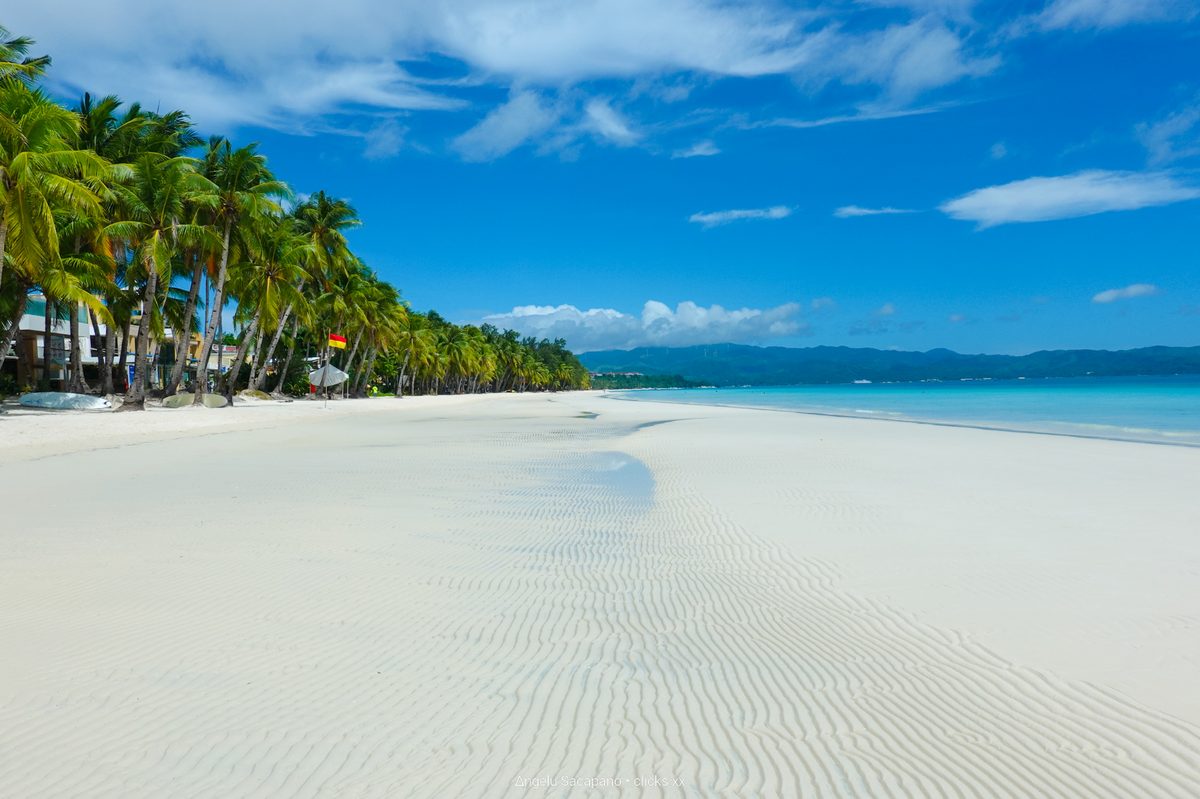
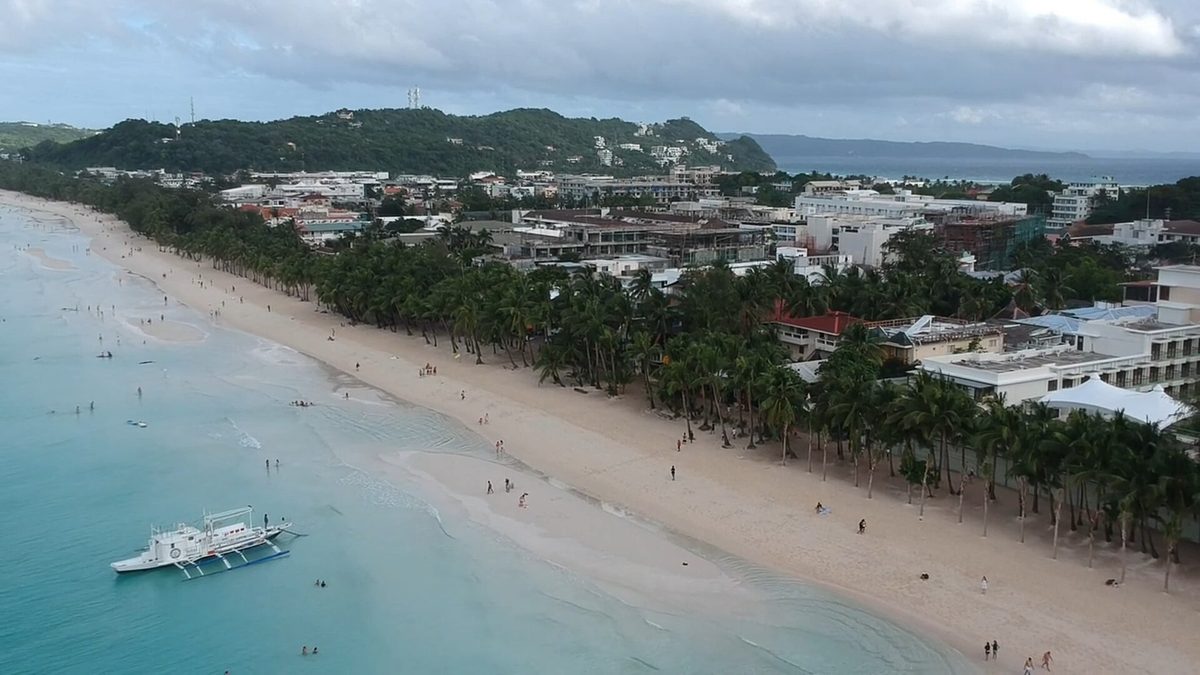
Boracay’s White Beach is a four-kilometre ribbon of powder-fine sand on the island’s western shore, split into three lettered “Stations” that each have a completely different personality. Station 1 is the wide, upscale north end; Station 2 is the busy heart with the shops and bars; Station 3 is the quieter, cheaper south. Pick the right stretch of White Beach Boracay and this ranks among the best beaches in Asia; pick the wrong one and you’ll spend your trip in the wrong crowd.
I’ve walked this beach end to end more times than I can count, at sunrise when the joggers own it and at 10pm when the bars take over. Below is the honest version of Boracay White Beach: which Station suits which traveller, where the sand is actually widest, when the water turns choppy, the seaweed truth nobody puts in the brochure, and what’s genuinely worth your pesos. Prices are 2026 ballparks in Philippine pesos with US dollars alongside, at roughly 58 PHP to the dollar. For the bigger island picture, our full Boracay travel guide covers transfers, where to base yourself, and the rest of the island.
White Beach at a glance: Station 1 vs 2 vs 3
If you read nothing else, read this table. The sand and the water are excellent the whole length of White Beach. What changes between the Stations is the scene behind the sand, the price of a bed, and how much elbow room you get.
| Station | Vibe | The sand | Crowd | Best for | Rough nightly rate |
|---|---|---|---|---|---|
| Station 1 (north) | Calm, polished, upscale | Widest and finest; shallow water far out | Lightest, even in peak season | Couples, families, anyone who wants space | ~PHP 6,000–25,000+ ($105–430+) |
| Station 2 (middle) | Buzzy, social, the beating centre | Good, a touch narrower; shallow | Heaviest, especially near D’Mall and at sunset | First-timers, foodies, nightlife, convenience | ~PHP 2,500–6,000 ($43–105) |
| Station 3 (south) | Mellow, leafy, low-key | Just as nice; drops off to deeper water sooner | Quietest stretch of the three | Backpackers, long stays, budget travellers | ~PHP 1,400–3,500 ($24–60) |
One thing that trips people up: there are no fences or signs marking where one Station ends and the next begins. Locals use the Stations the way you’d use street names, a leftover from the days when boats from the mainland dropped tourists at numbered “boat stations” along the sand. Walking the whole beach from the north tip of Station 1 to the south end of Station 3 takes about 20 to 25 minutes at a stroll, less if you’re not dodging beach photographers.
The three Stations of White Beach, in depth
This is the section most guides rush. Here’s where I’d actually put you depending on what you’re after; for the resort-by-resort version, our guide to where to stay in Boracay weighs the three Stations up in depth.
Station 1: the wide, quiet, expensive north end
White Beach Station 1 occupies the northern third of the beach, and it has the best sand on White Beach, full stop. The powder is finer and the beach is noticeably wider here, partly because the high-end resorts set back from the water and there’s no narrow walking path squeezing the sand. You get room to lay out a towel even at Christmas. The water stays shallow a long way out too; at the far north end near The Lind and Discovery Shores I’ve waded out fifty-odd metres and still been waist-deep, which makes it the most family-friendly stretch for small kids.
The trade-off is the price and the relative hush. This is where Boracay’s flagship properties sit: Shangri-La (technically just around the headland), Discovery Shores, The Lind, Henann Crystal Sands. There are fewer restaurants spilling onto the sand, so it never feels as loud or crowded as Station 2. If your idea of a good beach day is space, a book, and a sunset cocktail rather than a thumping bar, base yourself here. Station 1 is also where the sunset paraw sailboats launch from, and where you’ll find Willy’s Rock, the island’s most photographed landmark.
Station 2: D’Mall, the crowds, and the centre of everything
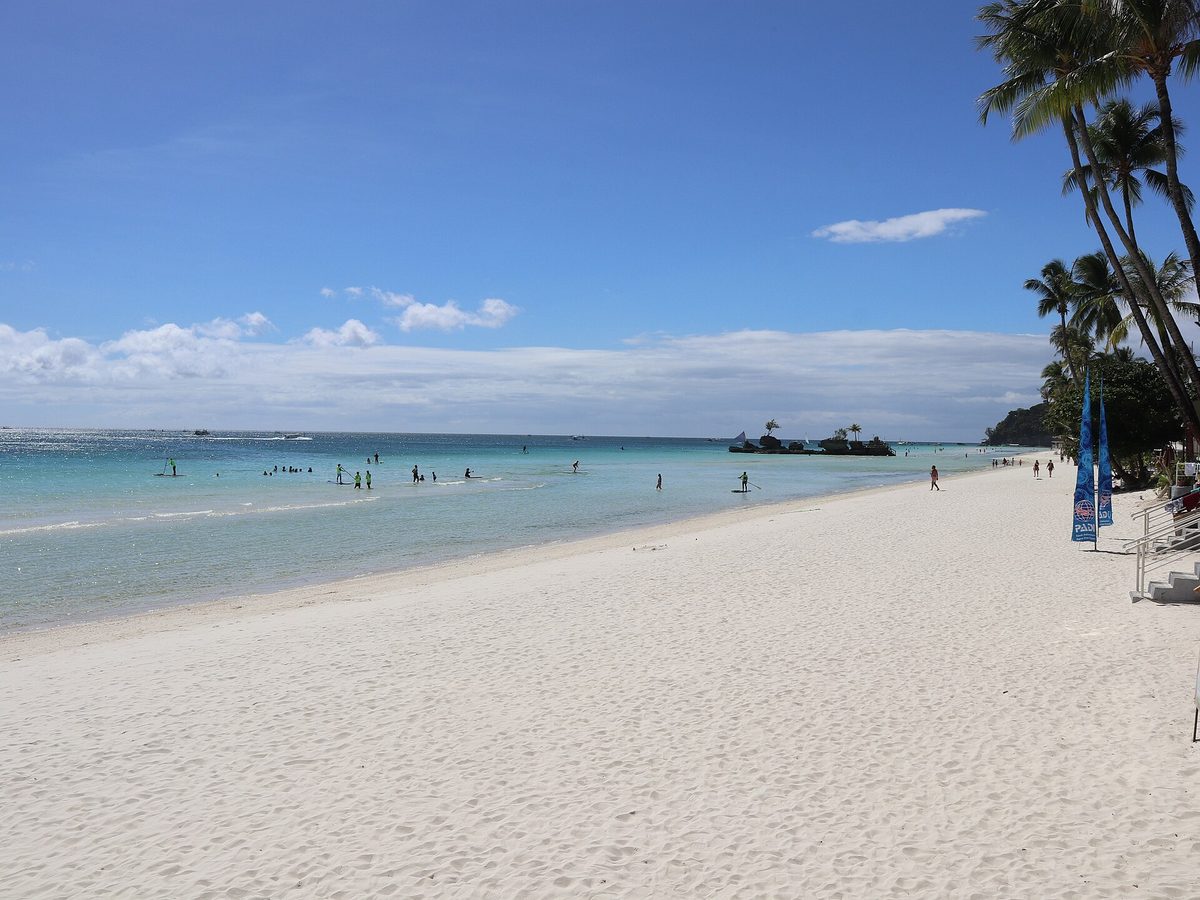
Station 2 is the engine room of White Beach. The big draw is D’Mall, an open-air maze of restaurants, dessert spots, dive shops, pharmacies, ATMs, souvenir stalls and a small grocery, all a two-minute walk back from the sand. Whatever you need, it’s here and it’s within walking distance, which is exactly why first-timers love this Station and why it’s the most convenient base on the island.
It’s also the busiest and most commercial stretch. The sand is a little narrower than Station 1 and gets genuinely crowded around sunset, when what feels like the whole island funnels onto this part of the beach for photos and the bars fire up. If you want your hotel, dinner, a massage, a dive booking and the nightlife all within a five-minute radius, Station 2 is unbeatable. If you’re chasing peace and quiet, it’s the one to avoid. Just south of D’Mall sits D’Talipapa, a wet market where you can buy fresh seafood and have a nearby eatery cook it for you, which remains one of the better-value meals on the beach.
Station 3: the mellow, budget-friendly south
Station 3 is where I’d send backpackers, long-stay travellers, and anyone who found Station 2 exhausting. The accommodation here skews budget and mid-range, the bars are more laid-back, and the whole stretch feels leafier and calmer. The beach itself is every bit as beautiful, with the same white sand, but there’s one real difference worth knowing: the seabed drops off more steeply here, so the water gets deep faster than the wade-forever shallows up north. That’s a plus if you actually want to swim properly and a minor watch-point if you have toddlers.
Station 3 also gives you the cheapest beds on White Beach and a more local, less polished feel. You’re still only a 10-to-15-minute walk from D’Mall, so you’re not cut off from anything; you just sleep somewhere quieter and pay a lot less for it. The far southern end (the Angol area) is the most peaceful spot on the entire beach.
The beachfront path, the back road, and how to get around
Here’s a distinction that confuses a lot of first-timers, because almost no one explains it. White Beach has two parallel arteries. The first is the beachfront path, a pedestrian walkway that runs the full length of the sand, separated from the beach itself by a line of coconut palms. This is where the restaurants, bars and dive shops have their frontages, and in the evening it turns into a slow river of people drifting between dinner and drinks. No cars, no tricycles, just foot traffic.
The second is the main road set further inland, where the tricycles and e-trikes run and where you’ll catch a ride between Stations or out to the ferry port. The two don’t touch along most of the beach; you cut between them down little connecting lanes. For getting around, walking the beachfront path is almost always the nicest option, and you genuinely never have to ride anything if you don’t want to. If your feet give out, a tricycle along the back road between Stations costs only around PHP 30 to 150 ($0.50–2.50) depending on distance and whether you charter it. For a fuller rundown of island activities beyond the sand, see our guide to things to do in Boracay.
Willy’s Rock: the icon of Station 1
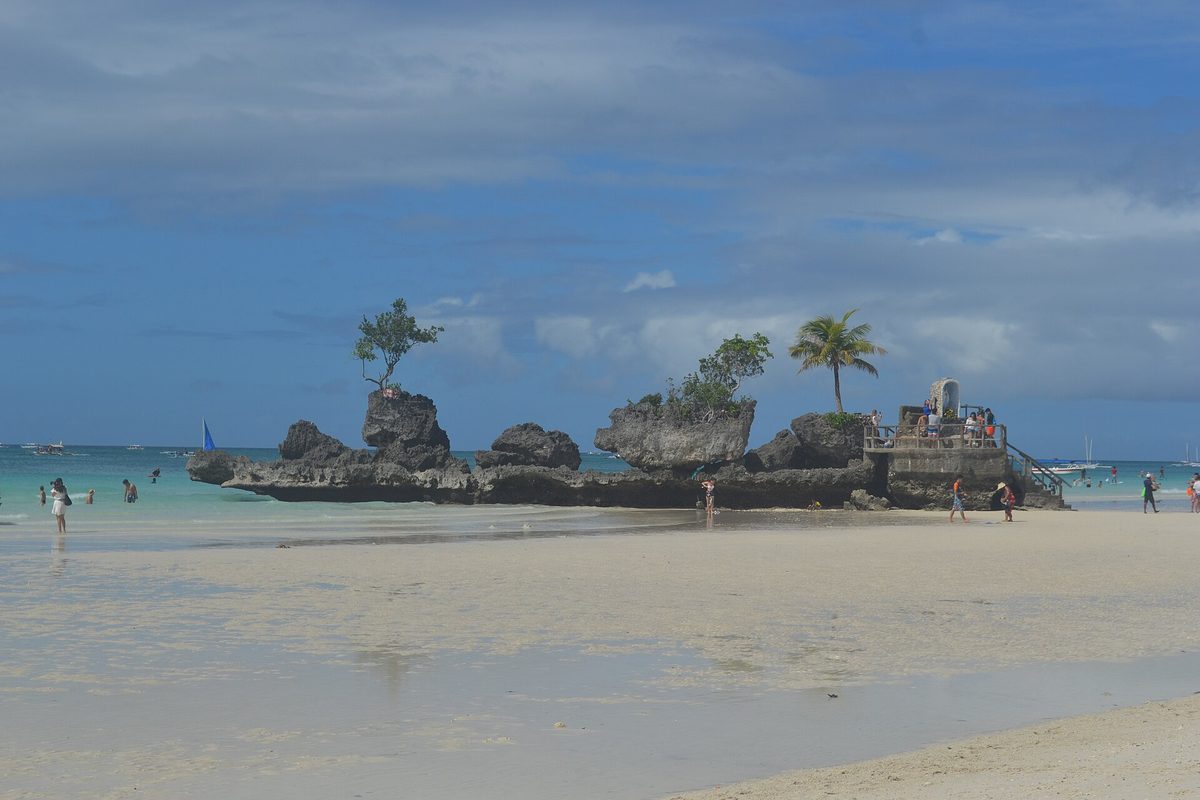
If one image says “Boracay,” it’s Willy’s Rock. This craggy volcanic outcrop sits in the shallows just off Station 1, crowned with a small shrine to the Virgin Mary that locals built decades ago, with stone steps cut up to it. It took its name from the old Willy’s Beach Club hotel right across from it on the sand.
Here’s the honest note: at high tide the rock is ringed by water and the steps can be slippery and off-limits, while at low tide you can walk right up to the base. Come at golden hour and you’ll have company: this is the single most popular photo spot on White Beach, and the silhouette of the rock against an orange sky is worth the elbowing. Go early morning instead and you might have it nearly to yourself.
The White Beach sunset and paraw sailing
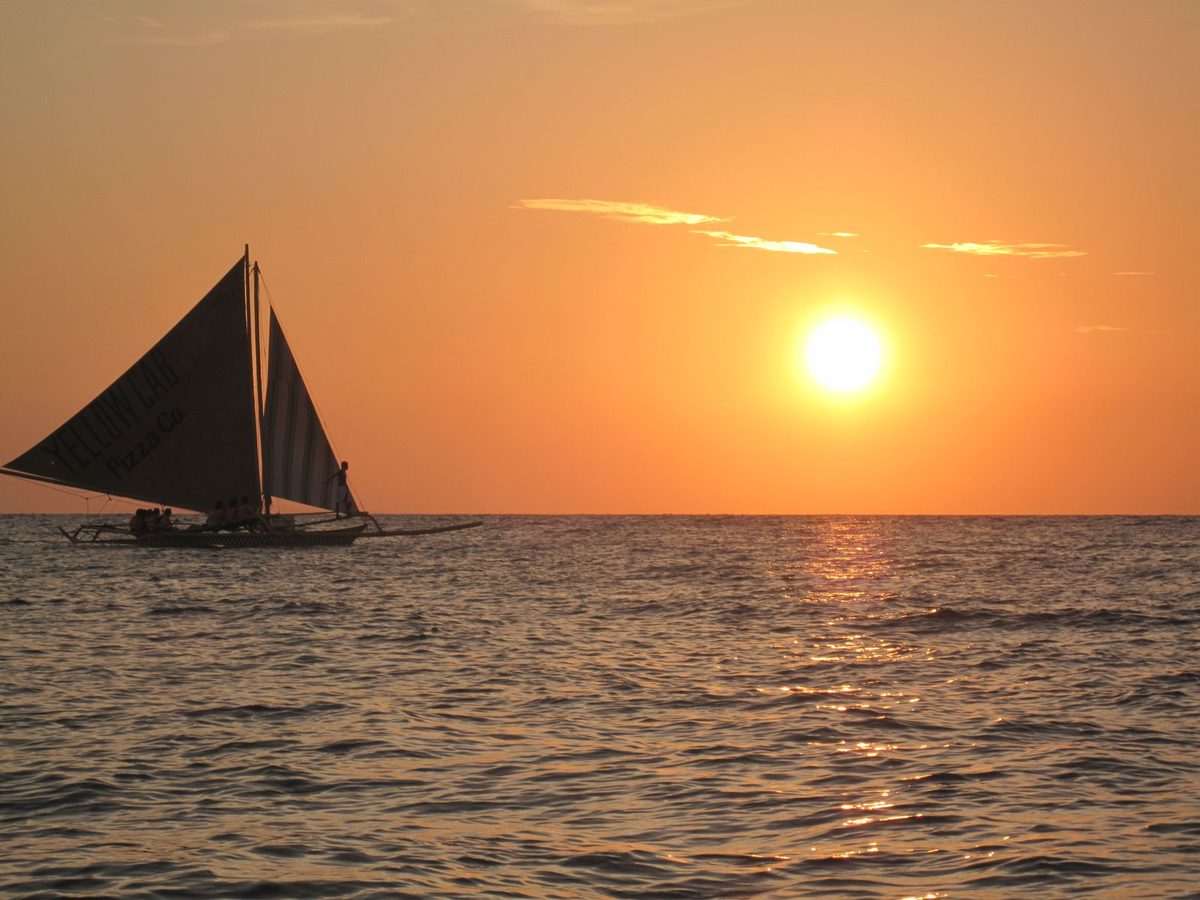
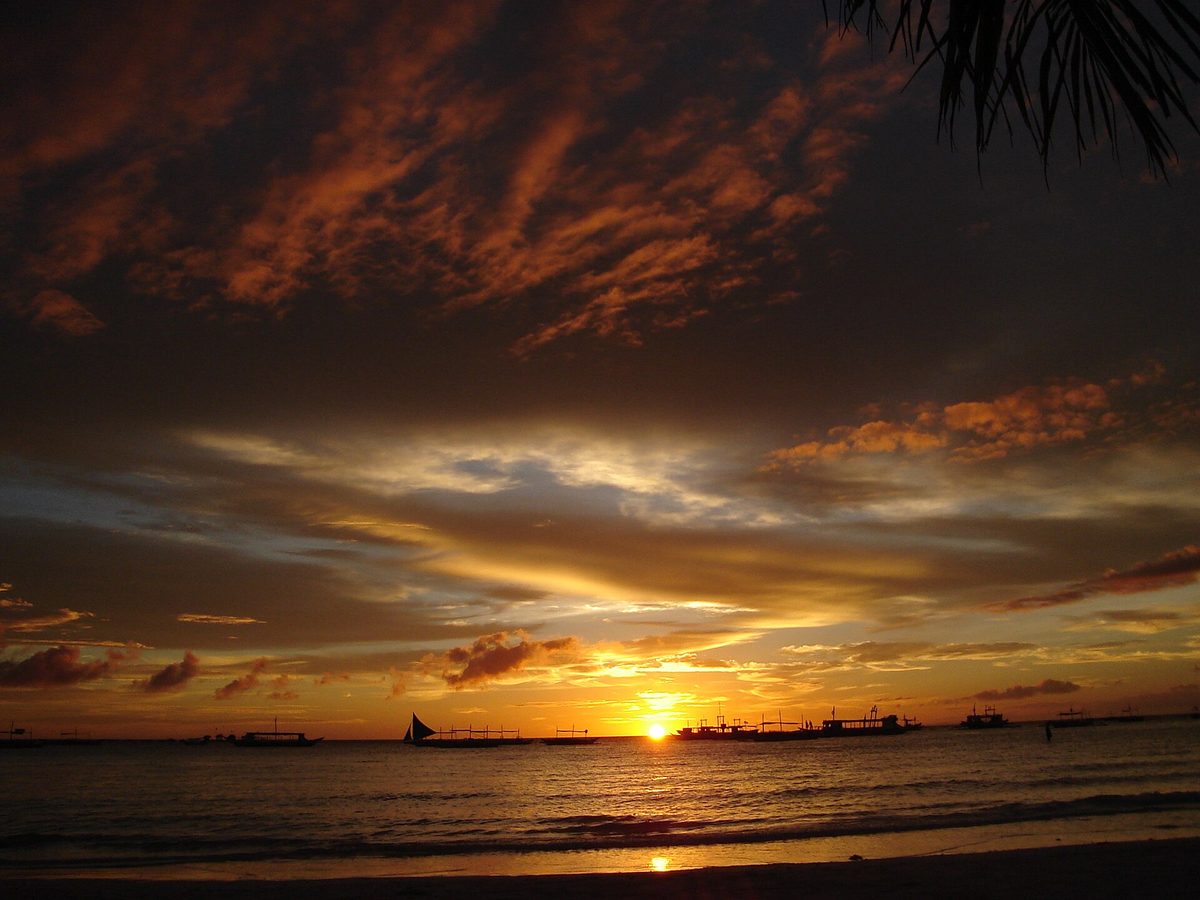
The White Beach sunset is the reason people fall in love with this place. The beach faces due west, the sun goes down around 6 pm pretty much year-round, and for the half hour either side of it the whole sky and sea go pink and gold. Get a fresh mango shake, find a spot on the sand, and watch.
The iconic way to do it is aboard a paraw, the traditional Filipino double-outrigger sailboat with its bright triangular sails. The boats launch mainly from around the Station 1–Station 2 border, and a sunset sail gets you out on the water for the golden hour with the island glowing behind you. It’s the one activity I’d tell anyone to do at least once. As of 2026, a shared 30-minute sunset paraw runs roughly PHP 600–1,000 ($10–17) per person if you join a group, while chartering your own private paraw typically starts around PHP 3,700–4,700 ($64–81) for the boat, not per head. Prices flex with season and how hard you haggle, so agree the rate before you step aboard. Book through a reputable beachfront operator rather than the first tout who approaches you.
Don’t want to pay? The sunset is free from the sand. Station 1 gives you the widest foreground and the fewest heads in front of your camera; walk north past the last of the bars and you’ll find a calmer stretch to watch it from. If you’re building a wider itinerary, our guide to the best beaches in the Philippines puts White Beach in context against its rivals.
Swimming and water quality, season by season
For most of the year White Beach is a dream to swim in: flat, clear, bath-warm water with a gentle sandy shelve. That’s the picture from roughly November to May, when the amihan (northeast monsoon) keeps the western shore sheltered and glassy. This is the classic swimming and postcard season.
From roughly June to October the habagat (southwest monsoon) flips the island. The wind now blows onto White Beach, so the water turns choppier with real waves (often knee- to waist-high, bigger in a blow), and August is typically the wettest, windiest month. You can still swim on plenty of habagat days, but it’s less reliably calm, and after a storm the shore can pick up debris. The upside is fewer crowds and the year’s lowest room rates. Note the mirror-image trick of Boracay: when White Beach is windy, Bulabog Beach on the east side goes calm, and vice versa, which is why the kitesurfers chase habagat. For a month-by-month breakdown, see our guide to the best time to visit Boracay.
The seaweed season, honestly
Here’s the thing the brochures leave out: for part of the year White Beach gets seaweed. Locals call it lumot, and it’s a seasonal algal bloom that drifts into the shallows, usually most noticeable from roughly February to early May. Counter-intuitively, that’s during the calm, sunny amihan season, not the rainy months, so don’t assume “dry season” automatically means perfect water.
Now the reassuring part. The lumot mostly sits in the first few metres of water right at the shoreline; wade past it and the water where you actually swim is usually clear. It’s not pollution; it’s a sign of a healthy reef system, and resort crews rake their frontages every morning. Most of the grim photos you see online are worst-case days, not the norm. If crystal water matters more to you than anything else, aim for roughly June to January, or book a resort with a deeper frontage. Separately, during habagat the wind-driven waves can wash up loose seagrass and flotsam onto the sand too, which is a different thing from the spring lumot bloom, but it’s why the shore isn’t always postcard-perfect in the wet months.
Where to eat along White Beach
You will not go hungry here. The densest cluster of restaurants is in and around D’Mall at Station 2, where you’ll find everything from wood-fired pizza and Italian at the long-running Aria, to burgers, rice bowls, and those absurdly large “couple-size” mango shaved-ice bowls. For the best value, head to D’Talipapa just south of D’Mall: pick your fish, prawns or crab from the wet market, haggle, then hand it to one of the surrounding eateries to grill for a small cooking fee.
A few honest pointers: the front-row tables right on the sand charge a premium for the view, and sometimes that sunset seat is worth it. But the small eateries one or two lanes back from the beachfront serve the same fresh seafood for considerably less. A sit-down main course runs roughly PHP 250–650 ($4–11) at casual spots and climbs fast at the beachfront and resort restaurants. One quirk: since the rehabilitation, eating and drinking directly on the sand is restricted, so you’ll usually dine at tables on the path side of the palms rather than on the beach itself.
Photography spots on White Beach
If you’re after the shots, here are the ones worth planning around:
- Willy’s Rock at sunset (Station 1) — the classic. Come at low tide for clean foreground reflections, or at golden hour for the silhouette.
- The wide sand at northern Station 1 — the best place for an uncluttered beach-and-sky frame without crowds in the background.
- On a paraw on the water — the sails framed against the sun going down are the signature Boracay image.
- The beachfront path at night — fairy lights in the palms and the glow of the bars make for a different, moodier set of shots.
- Early morning anywhere — for empty sand and soft light, be out before 7 am. It’s the only time you’ll get White Beach to yourself.
The rules, the setback, and why White Beach looks the way it does now
If you visited before 2018, White Beach looks different today, and that’s by design. In 2018 the Philippine government closed Boracay to tourists for six months to rehabilitate an island that had been overwhelmed by overdevelopment and weak sewerage. Part of the cleanup was enforcing a beach easement: structures that had crept right up to the sand were demolished back to a 25-metre (+5-metre) no-build line from the shoreline. That’s why the resorts now sit so far back, why the beach feels wider and more open, and why the beachfront path has room to breathe.
Along with the setback came a set of beach rules that are actively enforced by roving “beach police.” Worth knowing before you go:
- Single-use plastics (straws, sachets, disposable cups and bottles on the sand) are restricted. Bring a refillable bottle.
- Sandcastle building is now regulated, not banned. Suspended after the 2018 cleanup, the build-a-castle-for-a-tip trade was revived in 2025 under permits: builders must register with the Malay local government and the Boracay Sandcastle Makers Association, castles are capped at a five-metre footprint and about 1.5 metres high, and only seawater (no cement or chemicals) is allowed. You and the kids can build a small personal castle too, as long as you keep it tidy.
- No bonfires on the beach, and no fireworks without a permit.
- No smoking or vaping on the sand, and no littering.
- Alcohol and eating on the sand are restricted; glass is a no. In practice you’ll drink and dine at the bars and tables along the path rather than on the beach itself. Rules get tightened around holidays, so when in doubt, ask.
- No drones without a permit, and pets are generally not allowed on White Beach.
One more cost to budget for: getting onto the island isn’t free. As of 2026, foreign visitors pay an environmental fee of around PHP 300 ($5), charged once for your whole stay, plus a terminal fee of roughly PHP 150 ($2.50) each way (so paid on both arrival and departure), collected at the Caticlan jetty port (increasingly via the online Boracay iPass). Fees can change, so verify the current amounts before you travel. The beach itself is free to walk on once you’re here; there’s no gate and no admission ticket for White Beach. For a full breakdown of daily budgets across the country, see our guide to Philippines travel costs.
What to skip: an honest take
Not everything on White Beach is worth your time or money. A few candid calls:
- The pushiest beachfront touts. You’ll be offered boat trips, massages and sunglasses every few metres. A polite “no, salamat” and a smile does the job; never book an activity with the very first person who approaches you.
- Jet ski and parasailing at peak sunset hours. The water off Station 2 gets busy and the experience feels rushed. If you want them, go early in the day.
- Overpriced front-row set meals. The view is great, but you can eat the same food for half the price one lane back.
- Don’t skip the sunset paraw. Of everything sold on this beach, the sailboat at golden hour is the one I’d never talk you out of.
White Beach by season: Amihan vs Habagat
Boracay runs on two monsoons, and they change White Beach completely. Pick your dates with this in mind.
Amihan (roughly November–May) is the classic season. The northeast monsoon shelters the west-facing beach, so the water is calm, clear and flat, the skies are mostly blue, and swimming is at its best. This is also peak season: expect the biggest crowds and the highest room rates, especially over Christmas, New Year, Chinese New Year and Holy Week. The one asterisk is the lumot (seaweed) window around February to early May, covered above.
Habagat (roughly June–October) is the southwest monsoon and the wet season. The wind swings round to hit White Beach head-on, so you get choppier water, real waves, and short but heavy afternoon downpours; August is usually the wettest month and carries the highest typhoon risk. It’s far from a write-off, though: rain often comes in bursts rather than all day, prices drop sharply, the beach is blessedly uncrowded, and the lumot has usually cleared. If you’re a kitesurfer, this is actually your season — head to Bulabog on the east side, which comes alive when White Beach goes windy.
A first-timer’s guide to White Beach, Boracay
If this is your first trip and you want the short version: come in the amihan months for the calmest water, base yourself in Station 2 if you want everything on your doorstep or Station 1 if you want space, walk the beachfront path end to end at least once, see Willy’s Rock at low tide, and book a sunset paraw. Do those five things and you’ll understand why people keep coming back. If you’re still deciding between islands entirely, our Palawan vs Boracay comparison will help you choose.
Frequently asked questions
Is White Beach Boracay free?
The beach itself is free to walk on and swim at — there’s no gate or admission ticket for White Beach. You pay only to reach the island: a one-time environmental fee of around PHP 300 ($5) for your whole stay, plus a terminal fee of roughly PHP 150 ($2.50) each way at the Caticlan jetty port. Amounts can change, so verify the current rates.
Which Station of White Beach is best?
It depends on you. Station 1 (north) has the widest, finest sand and the upscale, quieter resorts. Station 2 (middle) is the busy centre with D’Mall, the food and the nightlife. Station 3 (south) is quieter and cheapest. Couples and families lean Station 1, first-timers Station 2, backpackers Station 3.
Can you swim at White Beach in Boracay?
Yes, and it’s excellent for most of the year. From November to May (amihan season) the water is calm, clear and shallow, especially at Station 1. During habagat (June to October) it can get choppy with waves, though you can often still swim. Station 3 drops off into deeper water sooner than the north end.
Why is the sand on White Beach so white?
White Beach’s talcum-fine, brilliant white sand is made largely of pulverised coral and the skeletal remains of marine organisms broken down over thousands of years. Because it’s coral-based rather than quartz, it stays remarkably cool underfoot even at midday, unlike the hot golden sand of many other beaches.
What is the best time for a White Beach sunset?
The sun sets around 6 pm pretty much year-round on this west-facing beach. Arrive by about 5:30 pm to settle in. For the best colour and fewest people in front of you, watch from Station 1 or book a sunset paraw sail. Clear, dry amihan evenings (November to May) give the most reliable sky.
Is White Beach good for families with young kids?
Very. Station 1 is the pick: the water stays shallow a long way out, the sand is wide and soft, and it’s the calmest, least crowded stretch. Avoid Station 3 with toddlers, since the seabed drops off faster there, and favour the calm amihan months over the wavier habagat season.
Sources and photo credits
Photo credits
- White Beach shoreline, Boracay — Jhun Sacapano, CC BY-SA 4.0, via Wikimedia Commons
- Willy’s Rock, Station 1 — Wallpaperhd.io, CC0, via Wikimedia Commons
- Sunset over White Beach — User:CollingsCamillaMs, Public domain, via Wikimedia Commons
- Paraw sailboat at sunset — Anthony Alger, CC BY-SA 3.0, via Wikimedia Commons
- D’Mall, Station 2 — Sarahr, Public domain, via Wikimedia Commons
- Station 1 wide sand — Patrickroque01, CC BY-SA 4.0, via Wikimedia Commons
- Aerial of White Beach — SkyVista Drone, CC BY 3.0, via Wikimedia Commons
Sources
- Philippine Department of Tourism — official travel portal
- Province of Aklan — Boracay iPass entry fees and requirements
- 2018 Boracay closure and redevelopment — background on the rehabilitation and easement
- Rappler — on Boracay’s regulation of sandcastle activities and beach rules
About this guide: PhilippinesTourism.org is an independent Philippines travel resource. This guide was researched and verified August 2026.
1 response
Comments are closed.